Water & Hydration Evidence Guide
Essential macronutrient and universal solvent vital for cellular volume maintenance, cardiovascular blood volume regulation, thermoregulatory sweating, synovial joint lubrication, and renal clearance of metabolic waste.
Quick Scientific Facts: Water & Hydration
Key physiological targets, upper safety bounds, and bioavailability metrics.
Why Water & Hydration Matters
Universal Biological Solvent • Essential Fluid Homeostasis
Water constitutes approximately 55% to 65% of adult human body mass. Fluid balance is continuously regulated by hypothalamic osmoreceptors, pituitary arginine vasopressin (AVP/ADH secretion), and the renal renin-angiotensin-aldosterone system (RAAS). Unlike micronutrients that act as enzyme cofactors, water acts as the physical cellular solvent, thermal buffer, and bulk transport medium for all physiological biochemistry.
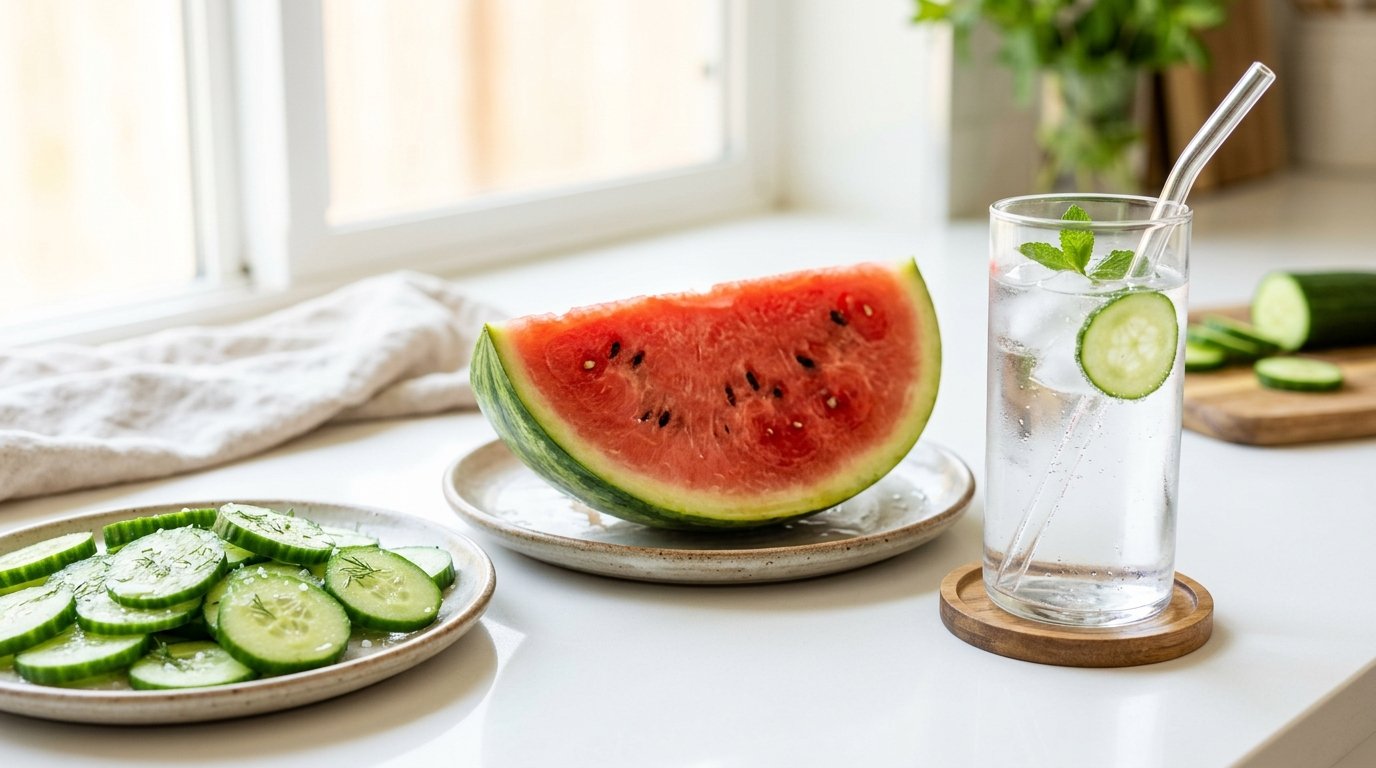
Pairing hydration with electrolyte-rich whole plant foods (cucumbers, leafy greens, oranges, watermelon, and coconut water) provides natural potassium and magnesium that enhance cellular uptake via the sodium-potassium ATPase pump without causing dilutional hyponatremia.
6-Stage Biological Journey: Water & Hydration
Interactive pathway mapping Water & Hydration ingestion, digestive release, membrane transport, and cellular bio-utilization.
Oral Fluid & Food Moisture
Water is ingested through pure liquids and cellular moisture extracted from raw fruits and vegetables.
Oral Mastication & Salivary Solubilization
High Whole Food Retention
Gastric Pass-Through
Best 100% Whole Food Plant-Based Sources of Water & Hydration
Top nutrient-dense plant foods ranked by % Daily Value per standard serving.
Fresh Cucumber
Fresh Celery
Romaine / Iceberg
Raw Zucchini
Fresh Tomatoes
Fresh Watermelon
Fresh Strawberries
Cantaloupe Melon
Recommended Daily Allowance (RDA) & DRI Standards: Water & Hydration
Dietary Reference Intakes (DRI) across human life stages established by the National Academies of Sciences.
| Life Stage Bracket | Requirement Target | Type | Upper Limit (UL) | Visual Scale |
|---|---|---|---|---|
| Infants (0–12 months) | 0.7 – 0.8 L / day | AI | Not Established | |
| Children (1–8 years) | 1.3 – 1.7 L / day | AI | Not Established | |
| Adolescents (14–18 years) | 3.3 L (M) / 2.3 L (F) | AI | Not Established | |
| Adult Male (19+ years) | 3.7 L / day (3,700 ml) | AI | Not Established (Fluid loading >1.0 L/hr) | |
| Adult Female (19+ years) | 2.7 L / day (2,700 ml) | AI | Not Established (Fluid loading >1.0 L/hr) | |
| Pregnancy (19+ years) | 3.0 L / day (3,000 ml) | AI | Not Established (Fluid loading >1.0 L/hr) | |
| Lactation (19+ years) | 3.8 L / day (3,800 ml) | AI | Not Established (Fluid loading >1.0 L/hr) | |
| Physical Exercise (Add-On) | Add +0.5 to +1.0 L / day | AI | Not Established (Fluid loading >1.0 L/hr) |
100% Daily Value Achievement Combinations: Water & Hydration
Practical whole-food meal pairings to hit 100% of your daily Water & Hydration requirement effortlessly.
1 Serving Fresh Cucumber
Prepared Raw Fresh for maximum retention.
1 Serving Fresh Celery + Romaine / Iceberg
Combined meal pairing for optimal Water & Hydration density.
Romaine / Iceberg + Raw Zucchini
Diverse whole-food combination across two meal windows.
5-Stage Deficiency Progression Timeline: Water & Hydration
Clinical timeline tracing tissue depletion from early asymptomatic bio-depletion to overt pathology for Water & Hydration. Educational deficiency progression model
Biochemical Biomarkers
- Intravascular plasma volume contracts by 5%–10%
- Elevated sub-maximal heart rate to maintain cardiac output
- Decreased skin blood flow & impaired thermoregulatory sweating
Clinical Symptoms
- Prominent headache, fatigue & lightheadedness upon standing
- Flushed, dry skin & reduced skin turgor
- Oliguria with dark amber, highly concentrated urine
100% WFPB Therapeutic Protocol
Administer oral rehydration with water + natural whole plant electrolytes (potassium, sodium from coconut water & leafy greens).
Interactive Toxicity & Tolerable Upper Intake Level (UL): Water & Hydration
Drag the slider to evaluate biological safety margins, upper intake ceilings, and toxicity thresholds for Water & Hydration.
2.5 – 3.7 L / day (Adequate Intake)
3.7 – 5.0 L / day (Active / Warm Climate)
Not Established for Normal Daily Diet
> 1.0 L / hour sustained without electrolytes
✅ Optimal Bio-Physiological Baseline (100% RDA)
Acute water intoxication (dilutional hyponatremia) occurs when fluid intake exceeds the maximum renal excretion rate (~800–1,000 mL/hr), causing serum sodium to fall below 135 mmol/L with cellular swelling and cerebral edema.
Water & Hydration Reference Calculator
Estimate your daily Water & Hydration reference target using established Dietary Reference Intakes and relevant life-stage factors.
7-Day WFPB Meal Planner & Macro Balancer: Water & Hydration
Scientifically calculated 100% plant-based meal plan optimized for Water & Hydration density and bio-absorption.
400 ml Pure Water + Fresh Oatmeal with Berries
Hydrating Cucumber, Tomato & Chickpea Power Bowl
Chilled Herbal Infusion + Fresh Watermelon Slices
Steamed Zucchini, Kale & Lentil Stew with Water Sauté
Categorized 100% WFPB Shopping List: Water & Hydration
Interactive grocery checklist organized by plant food category to hit your weekly Water & Hydration targets.
🛒 High-Water Produce (90-96% H2O)
🛒 Hydrating Herbal Teas
Research & Evidence Intelligence Dashboard: Water & Hydration
Human clinical trial meta-analyses, publication trends, and consensus confidence grades for Water & Hydration.
No verified research data available
Clinical trials and meta-analyses for Water & Hydration are currently being indexed.
Official Scientific Research Authorities: Water & Hydration
Verified data sources establishing international dietary standards and clinical recommendations for Water & Hydration.
USDA FoodData Central
VerifiedStandard Reference analytical database for 100% whole plant food micronutrient density.
NIH Office of Supplements
VerifiedNational Institutes of Health official DRI intake tables and deficiency research.
World Health Organization
VerifiedWHO/FAO expert consultation on human vitamin and mineral requirements.
NASEM Food & Nutrition
VerifiedNational Academies of Sciences evaluation of tolerable upper intake levels (UL).
Water & Hydration Knowledge Graph Explorer
Explore multi-dimensional entity connections linking Water & Hydration to plant food matrices, physiological functions, and health outcomes.
Frequently Asked Questions: Water & Hydration
Peer-reviewed answers to common questions regarding Water & Hydration bioavailability, absorption, and safety.
Does the classic "8 glasses a day" rule have strong scientific backing?
The popular "8x8 rule" (64 oz or ~1.9 L) is a simplified baseline. The official National Academy of Medicine (NASEM) DRI guidelines recommend 3.7 Liters/day for adult males and 2.7 Liters/day for adult females from total fluid intake, including water contained in moisture-rich whole plant foods.
Do water-rich fruits and vegetables count toward my daily hydration?
Yes. On a whole-food plant-based diet, fresh fruits and vegetables (such as cucumbers, watermelon, celery, and tomatoes, which are 90–96% water) typically contribute 20% to 30% of total daily hydration needs.
Can drinking too much water cause health risks?
Yes. Consuming excessive water (typically exceeding 1.0 Liter per hour for several consecutive hours) without electrolytes can overwhelm normal renal clearance (~800–1,000 mL/hr) and lead to dilutional hyponatremia (water intoxication).
Does moderate coffee or tea intake cause dehydration?
No. Clinical trials show that moderate caffeine consumption (under 400 mg/day, or 3–4 cups of coffee/tea) contributes positively to total daily fluid balance without causing net dehydration in habitual consumers.
What is the most reliable clinical indicator of adequate hydration?
Urine color (ranging from pale straw to light lemonade) and natural thirst sensation are the most accessible and reliable clinical markers of healthy daily hydration status.
Peer-Reviewed Scientific References: Water & Hydration
Official clinical guidelines, NIH Dietary Reference Intakes, and peer-reviewed journal articles for Water & Hydration.