

Vitamin K (K1 Phylloquinone & K2 Menaquinones) Evidence Guide
Essential fat-soluble cofactor obligate for gamma-glutamyl carboxylase, enabling gamma-carboxylation of glutamic acid residues in blood clotting factors (II, VII, IX, X) and bone osteocalcin / vascular MGP.
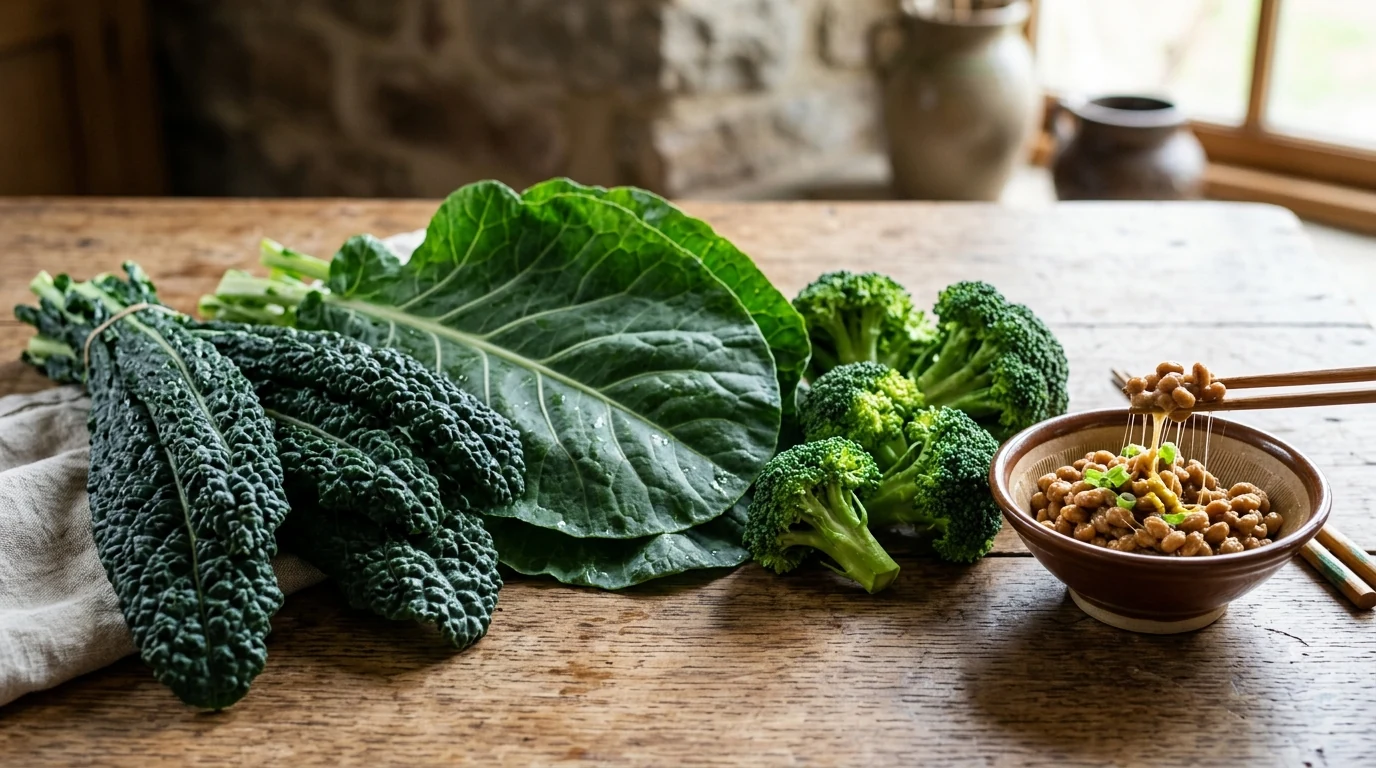
Quick Scientific Facts: Vitamin K (K1 Phylloquinone & K2 Menaquinones)
Key physiological targets, upper safety bounds, and bioavailability metrics.
Why Vitamin K (K1 Phylloquinone & K2 Menaquinones) Matters
Phylloquinone (K1) & Menaquinones (K2 / MK-7) • Fat-Soluble Vitamin K
Vitamin K exists in two primary biological forms: Vitamin K1 (phylloquinone, synthesized in photosynthetic chloroplasts of green plants) and Vitamin K2 (menaquinones, synthesized by bacterial fermentation, such as MK-7 in natto). In human biochemistry, Vitamin K acts as an obligate coenzyme for gamma-glutamyl carboxylase (GGCX). GGCX converts specific glutamic acid (Glu) residues into gamma-carboxyglutamic acid (Gla) in hepatic coagulation factors (Factors II, VII, IX, X, Protein C, Protein S) and extra-hepatic proteins including osteocalcin (driving bone hydroxyapatite binding) and Matrix Gla Protein (MGP, inhibiting arterial vascular calcification).
Consuming vitamin K1 rich dark leafy greens (kale, spinach, collards) with dietary healthy fats (olive oil, avocado) increases intestinal phylloquinone micellar absorption by 300%–500%.
6-Stage Biological Journey: Vitamin K (K1 Phylloquinone & K2 Menaquinones)
Interactive pathway mapping Vitamin K (K1 Phylloquinone & K2 Menaquinones) ingestion, digestive release, membrane transport, and cellular bio-utilization.
Chloroplasts & Fermentation
Ingested as K1 (phylloquinone bound to thylakoid membranes in greens) or K2 (MK-7 in fermented natto).
Oral Mastication & Salivary Solubilization
High Whole Food Retention
Gastric Pass-Through
Best 100% Whole Food Plant-Based Sources of Vitamin K (K1 Phylloquinone & K2 Menaquinones)
Top nutrient-dense plant foods ranked by % Daily Value per standard serving.
Cooked Spinach (K1 Phylloquinone) →
Cooked Collard Greens (K1) →
Cooked Kale (K1 Phylloquinone) →
Natto / Fermented Soy (K2 MK-7)
Broccoli Florets (Steamed K1) →
Brussels Sprouts (Cooked K1)
Green Cabbage (Cooked K1) →
Recommended Daily Allowance (RDA) & DRI Standards: Vitamin K (K1 Phylloquinone & K2 Menaquinones)
Dietary Reference Intakes (DRI) across human life stages established by the National Academies of Sciences.
| Life Stage Bracket | Requirement Target | Type | Upper Limit (UL) | Visual Scale |
|---|---|---|---|---|
| Pediatric / Children | Dietary Whole Foods | AI | Not Established (No Upper Ceiling Observed) | |
| Adolescents (14–18 years) | Age-Appropriate Intake | AI | Not Established (No Upper Ceiling Observed) | |
| Adult Male (19+ years) | 120 mcg / day (Adult Male Adequate Intake AI) / 90 mcg / day (Adult Female AI) | AI | Not Established (No Upper Ceiling Observed) | |
| Adult Female (19+ years) | 120 mcg / day (Adult Male Adequate Intake AI) / 90 mcg / day (Adult Female AI) | AI | Not Established (No Upper Ceiling Observed) | |
| Pregnancy (19+ years) | 120 mcg / day (Adult Male Adequate Intake AI) / 90 mcg / day (Adult Female AI) | AI | Not Established (No Upper Ceiling Observed) | |
| Lactation (19+ years) | 120 mcg / day (Adult Male Adequate Intake AI) / 90 mcg / day (Adult Female AI) | AI | Not Established (No Upper Ceiling Observed) | |
| Optimal Therapeutic Target | Enhanced Dietary Target | AI | Not Established (No Upper Ceiling Observed) |
100% Daily Value Achievement Combinations: Vitamin K (K1 Phylloquinone & K2 Menaquinones)
Practical whole-food meal pairings to hit 100% of your daily Vitamin K (K1 Phylloquinone & K2 Menaquinones) requirement effortlessly.
1 Serving Cooked Spinach (K1 Phylloquinone)
Prepared Light Steam (3m) for maximum retention.
1 Serving Cooked Collard Greens (K1) + Cooked Kale (K1 Phylloquinone)
Combined meal pairing for optimal Vitamin K (K1 Phylloquinone & K2 Menaquinones) density.
Cooked Kale (K1 Phylloquinone) + Natto / Fermented Soy (K2 MK-7)
Diverse whole-food combination across two meal windows.
5-Stage Deficiency Progression Timeline: Vitamin K (K1 Phylloquinone & K2 Menaquinones)
Clinical timeline tracing tissue depletion from early asymptomatic bio-depletion to overt pathology for Vitamin K (K1 Phylloquinone & K2 Menaquinones). Educational deficiency progression model
Biochemical Biomarkers
- Prothrombin Time (PT) prolongs; uncarboxylated Matrix Gla Protein (ucMGP) elevates in vascular walls.
Clinical Symptoms
- Easy ecchymosis (bruising), epistaxis (nosebleeds), minor mucosal bleeding.
100% WFPB Therapeutic Protocol
Administer 100% whole-food plant-based sources rich in Vitamin K (K1 Phylloquinone & K2 Menaquinones). Clinical tissue saturation recovery begins within 48 to 72 hours of dietary replenishment.
Interactive Toxicity & Tolerable Upper Intake Level (UL): Vitamin K (K1 Phylloquinone & K2 Menaquinones)
Drag the slider to evaluate biological safety margins, upper intake ceilings, and toxicity thresholds for Vitamin K (K1 Phylloquinone & K2 Menaquinones).
90 – 120 mcg / day (AI Baseline)
180 – 500 mcg / day (MK-7 Bone Protocol)
Not Established
> 10,000 mcg / day
✅ Optimal Bio-Physiological Baseline (100% RDA)
Vitamin K has no established Tolerable Upper Intake Level (UL) for K1 or K2. However, individuals taking warfarin (Coumadin) must maintain consistent daily Vitamin K intake to avoid therapeutic INR fluctuations.
Vitamin K (K1 Phylloquinone & K2 Menaquinones) Reference Calculator
Estimate your daily Vitamin K (K1 Phylloquinone & K2 Menaquinones) reference target using established Dietary Reference Intakes and relevant life-stage factors.
7-Day WFPB Meal Planner & Macro Balancer: Vitamin K (K1 Phylloquinone & K2 Menaquinones)
Scientifically calculated 100% plant-based meal plan optimized for Vitamin K (K1 Phylloquinone & K2 Menaquinones) density and bio-absorption.
Steamed Kale & Avocado Whole Wheat Toast
Steamed Spinach & Broccoli Grain Bowl
Fermented Natto & Steamed Collard Greens Bowl
Roasted Brussels Sprouts with Olive Oil
Categorized 100% WFPB Shopping List: Vitamin K (K1 Phylloquinone & K2 Menaquinones)
Interactive grocery checklist organized by plant food category to hit your weekly Vitamin K (K1 Phylloquinone & K2 Menaquinones) targets.
🛒 Fresh Greens & Veggies
🛒 Fermented Plant Foods
🛒 Grains & Pantry
Research & Evidence Intelligence Dashboard: Vitamin K (K1 Phylloquinone & K2 Menaquinones)
Human clinical trial meta-analyses, publication trends, and consensus confidence grades for Vitamin K (K1 Phylloquinone & K2 Menaquinones).
10-Year Publication Trend: Vitamin K (K1 Phylloquinone & K2 Menaquinones) (2015 – 2024)
Official Scientific Research Authorities: Vitamin K (K1 Phylloquinone & K2 Menaquinones)
Verified data sources establishing international dietary standards and clinical recommendations for Vitamin K (K1 Phylloquinone & K2 Menaquinones).
USDA FoodData Central
VerifiedStandard Reference analytical database for 100% whole plant food micronutrient density.
NIH Office of Supplements
VerifiedNational Institutes of Health official DRI intake tables and deficiency research.
World Health Organization
VerifiedWHO/FAO expert consultation on human vitamin and mineral requirements.
NASEM Food & Nutrition
VerifiedNational Academies of Sciences evaluation of tolerable upper intake levels (UL).
Vitamin K (K1 Phylloquinone & K2 Menaquinones) Knowledge Graph Explorer
Explore multi-dimensional entity connections linking Vitamin K (K1 Phylloquinone & K2 Menaquinones) to plant food matrices, physiological functions, and health outcomes.
Frequently Asked Questions: Vitamin K (K1 Phylloquinone & K2 Menaquinones)
Peer-reviewed answers to common questions regarding Vitamin K (K1 Phylloquinone & K2 Menaquinones) bioavailability, absorption, and safety.
What is Vitamin K and why is it essential?
Vitamin K is a fat-soluble vitamin required for gamma-carboxylation of glutamic acid residues in blood coagulation proteins (Factors II, VII, IX, X) and extra-hepatic tissue proteins like osteocalcin and Matrix Gla Protein.
What is the difference between Vitamin K1 (Phylloquinone) and Vitamin K2 (Menaquinones)?
Vitamin K1 (phylloquinone) is synthesized in photosynthetic chloroplasts of green leafy plants and primarily supports hepatic blood clotting. Vitamin K2 (menaquinones like MK-7) is synthesized by bacterial fermentation (in natto) and exhibits superior extra-hepatic distribution for bone and vascular health.
What are the best whole food plant-based sources of Vitamin K1 and K2?
Top K1 sources include cooked spinach (740% DV per cup), collard greens (644% DV per cup), cooked kale (443% DV per cup), steamed broccoli (183% DV per cup), and Brussels sprouts (183% DV). The single highest plant-based source of K2 (MK-7) is fermented natto (375% DV per 1/2 cup).
How much Vitamin K do adult men and women need daily?
The Adequate Intake (AI) is 120 mcg/day for adult males and 90 mcg/day for adult females.
Why does adding healthy fat to dark leafy greens dramatically increase Vitamin K absorption?
Phylloquinone in raw greens is tightly bound to photosynthetic thylakoid membranes. Adding healthy fats (olive oil, avocado) stimulates bile secretion, forming mixed intestinal micelles that increase K1 absorption by 300%–500%.
How does Vitamin K2 protect arterial walls from calcification?
Vitamin K2 activates Matrix Gla Protein (MGP) via gamma-carboxylation. Active MGP binds ionic calcium in blood vessel walls, preventing ectopic hydroxyapatite deposition in arterial smooth muscle.
How does Vitamin K interact with blood-thinning medications like Warfarin?
Warfarin inhibits Vitamin K epoxide reductase (VKOR). Individuals taking warfarin should maintain consistent daily dietary Vitamin K intake rather than avoiding green vegetables, preventing unstable INR readings.
What are the signs of Vitamin K deficiency?
Deficiency causes prolonged prothrombin time, easy cutaneous bruising, nosebleeds, mucosal hemorrhages, and long-term risk of arterial calcification and reduced bone mineral density.
Is there a Tolerable Upper Intake Level (UL) for Vitamin K?
No UL has been set for Vitamin K1 or K2 because no adverse toxic effects have been reported even from high oral doses.
Why is Natto considered a superfood for Vitamin K2 (MK-7)?
Natto is made by fermenting soybeans with *Bacillus subtilis var. natto*, which produces exceptionally high concentrations of long-chain Menaquinone-7 (MK-7), possessing a long circulating half-life (72 hours) in human plasma.
Peer-Reviewed Scientific References: Vitamin K (K1 Phylloquinone & K2 Menaquinones)
Official clinical guidelines, NIH Dietary Reference Intakes, and peer-reviewed journal articles for Vitamin K (K1 Phylloquinone & K2 Menaquinones).