Vitamin C Evidence Guide
Essential water-soluble micronutrient and potent antioxidant vital for prolyl hydroxylase collagen synthesis, immune defense, non-heme plant iron reduction, and cellular oxidative protection.
Quick Scientific Facts: Vitamin C
Key physiological targets, upper safety bounds, and bioavailability metrics.
Why Vitamin C Matters
L-Ascorbic Acid • Water-Soluble Micronutrient
As an obligate dietary nutrient, Vitamin C serves as an electron donor in key enzymatic reactions, maintaining iron and copper in their reduced states. It is indispensable for connective tissue collagen triple-helix assembly, vascular permeability regulation, neuroprotection, and systemic immune leukocyte activation.
Vitamin C can enhance absorption of non-heme iron from plant foods, with the effect varying by meal composition and iron status.
6-Stage Biological Journey: Vitamin C
Interactive pathway mapping Vitamin C ingestion, digestive release, membrane transport, and cellular bio-utilization.
Ascorbate Matrix
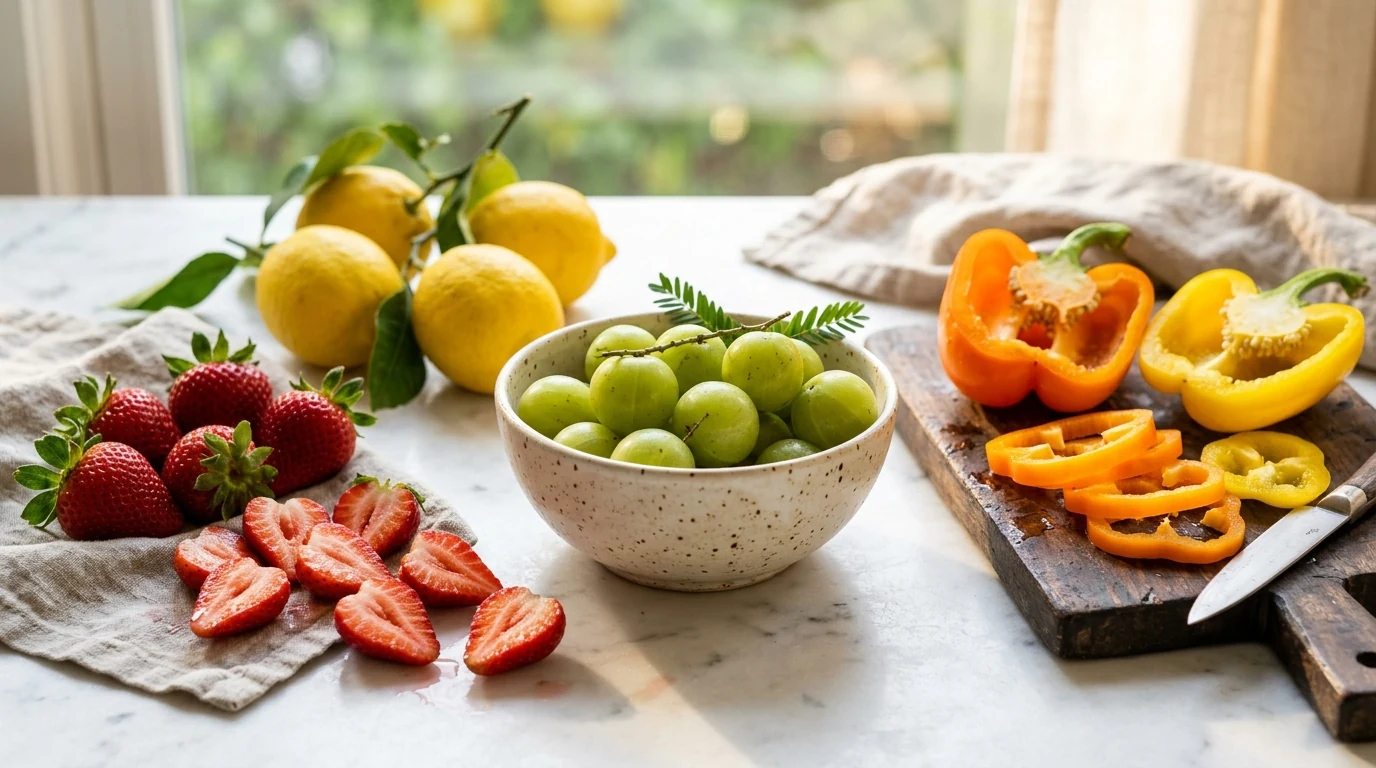
Ingested from citrus, bell peppers, Kakadu plum, and dark greens in a raw plant matrix.
Oral Mastication & Salivary Solubilization
High Whole Food Retention
Gastric Pass-Through
Best 100% Whole Food Plant-Based Sources of Vitamin C
Top nutrient-dense plant foods ranked by % Daily Value per standard serving.
Kakadu Plum (Fresh Whole Fruit)
Red Bell Pepper (Sweet, raw) →
Guava (Common, raw)
Broccoli Florets (Steamed) →
Kiwifruit (Green, raw)
Kale (Curly, raw) →
Recommended Daily Allowance (RDA) & DRI Standards: Vitamin C
Dietary Reference Intakes (DRI) across human life stages established by the National Academies of Sciences.
| Life Stage Bracket | Requirement Target | Type | Upper Limit (UL) | Visual Scale |
|---|---|---|---|---|
| Infants (0–12 months) | 40 – 50 mg / day | AI | Not Established | |
| Children (1–8 years) | 15 – 25 mg / day | RDA | 400 – 650 mg | |
| Adolescents (14–18 years) | 75 mg (M) / 65 mg (F) | RDA | 1,800 mg / day | |
| Adult Male (19+ years) | 90 mg / day | RDA | 2,000 mg / day | |
| Adult Female (19+ years) | 75 mg / day | RDA | 2,000 mg / day | |
| Pregnancy (19+ years) | 85 mg / day | RDA | 2,000 mg / day | |
| Lactation (19+ years) | 120 mg / day | RDA | 2,000 mg / day | |
| Smokers / Oxidative Stress | Add +35 mg / day | RDA | 2,000 mg / day |
100% Daily Value Achievement Combinations: Vitamin C
Practical whole-food meal pairings to hit 100% of your daily Vitamin C requirement effortlessly.
1 Serving Kakadu Plum (Fresh Whole Fruit)
Prepared Raw Fresh for maximum retention.
1 Serving Red Bell Pepper (Sweet, raw) + Guava (Common, raw)
Combined meal pairing for optimal Vitamin C density.
Guava (Common, raw) + Broccoli Florets (Steamed)
Diverse whole-food combination across two meal windows.
5-Stage Deficiency Progression Timeline: Vitamin C
Clinical timeline tracing tissue depletion from early asymptomatic bio-depletion to overt pathology for Vitamin C. Educational deficiency progression model
Biochemical Biomarkers
- Plasma ascorbate < 11 µmol/L; defective hydroxyproline synthesis.
Clinical Symptoms
- Perifollicular hemorrhages, corkscrew hairs, bleeding gums.
100% WFPB Therapeutic Protocol
Administer 200 – 500 mg daily whole-food ascorbate.
Interactive Toxicity & Tolerable Upper Intake Level (UL): Vitamin C
Drag the slider to evaluate biological safety margins, upper intake ceilings, and toxicity thresholds for Vitamin C.
75 – 120 mg / day
120 – 1,000 mg / day
2,000 mg / day
> 2,000 mg / day
✅ Optimal Bio-Physiological Baseline (100% RDA)
Doses exceeding the 2,000 mg/day UL overwhelm active intestinal SVCT1 absorption, leading to unabsorbed ascorbate in the colon and potential osmotic diarrhea or hyperoxaluria in renal patients.
Vitamin C Reference Calculator
Estimate your daily Vitamin C reference target using established Dietary Reference Intakes and relevant life-stage factors.
7-Day WFPB Meal Planner & Macro Balancer: Vitamin C
Scientifically calculated 100% plant-based meal plan optimized for Vitamin C density and bio-absorption.
Kiwi & Berry Oatmeal Bowl
Raw Red Bell Pepper & Hummus Wrap with Kale
Steamed Broccoli & Tofu Stir-Fry
Fresh Guava or Orange Segments
Categorized 100% WFPB Shopping List: Vitamin C
Interactive grocery checklist organized by plant food category to hit your weekly Vitamin C targets.
🛒 Fresh Produce
🛒 Legumes & Plant Proteins
🛒 Nuts & Seeds
Research & Evidence Intelligence Dashboard: Vitamin C
Human clinical trial meta-analyses, publication trends, and consensus confidence grades for Vitamin C.
10-Year Publication Trend: Vitamin C (2015 – 2024)
Official Scientific Research Authorities: Vitamin C
Verified data sources establishing international dietary standards and clinical recommendations for Vitamin C.
USDA FoodData Central
VerifiedStandard Reference analytical database for 100% whole plant food micronutrient density.
NIH Office of Supplements
VerifiedNational Institutes of Health official DRI intake tables and deficiency research.
World Health Organization
VerifiedWHO/FAO expert consultation on human vitamin and mineral requirements.
NASEM Food & Nutrition
VerifiedNational Academies of Sciences evaluation of tolerable upper intake levels (UL).
Vitamin C Knowledge Graph Explorer
Explore multi-dimensional entity connections linking Vitamin C to plant food matrices, physiological functions, and health outcomes.
Frequently Asked Questions: Vitamin C
Peer-reviewed answers to common questions regarding Vitamin C bioavailability, absorption, and safety.
Does cooking destroy Vitamin C in whole plant foods?
Vitamin C is heat-sensitive and water-soluble. Boiling in water can leach 40%–60% of ascorbate. However, light steaming for 3–5 minutes or raw consumption retains up to 90%.
Can human cells produce Vitamin C endogenously?
No. Humans cannot synthesize vitamin C endogenously due to a loss-of-function mutation in the GULO gene, making it an obligate dietary nutrient.
How does Vitamin C enhance non-heme plant iron absorption?
Ascorbic acid acts as a powerful reducing agent, converting insoluble ferric iron (Fe³⁺) into soluble ferrous iron (Fe²⁺) in the stomach, preventing phytate binding.
Peer-Reviewed Scientific References: Vitamin C
Official clinical guidelines, NIH Dietary Reference Intakes, and peer-reviewed journal articles for Vitamin C.