Vitamin B7 (Biotin) Evidence Guide
Essential water-soluble cofactor obligate for pyruvate carboxylase, acetyl-CoA carboxylase, and propionyl-CoA carboxylase, governing gluconeogenesis, fatty acid synthesis, and keratin hair/nail integrity.
Quick Scientific Facts: Vitamin B7 (Biotin)
Key physiological targets, upper safety bounds, and bioavailability metrics.
Why Vitamin B7 (Biotin) Matters
Biotin • Coenzyme for Carboxylase Enzymes
Biotin (Vitamin B7, formerly Vitamin H) functions as an obligate covalent coenzyme for five ATP-dependent carboxylase enzymes: acetyl-CoA carboxylase 1 and 2, pyruvate carboxylase, propionyl-CoA carboxylase, and beta-methylcrotonyl-CoA carboxylase. Through these carboxylases, biotin transfers carbon dioxide ($ ext{CO}_2$) moieties, enabling gluconeogenesis, fatty acid synthesis, and branched-chain amino acid catabolism. Additionally, holocarboxylase synthetase attaches biotin to histone proteins, regulating chromatin structure and cell proliferation.
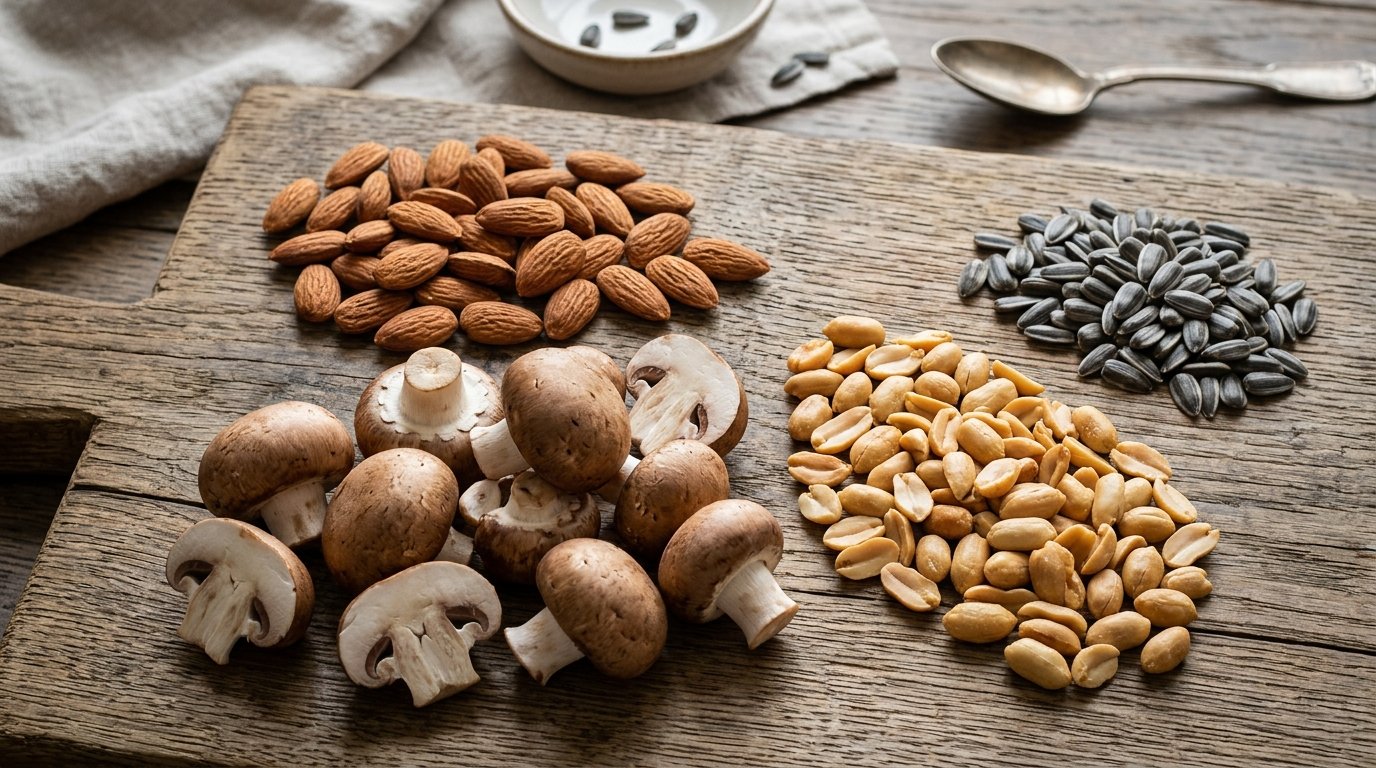
Pairing biotin-rich peanuts, almonds, and sunflower seeds with whole grain oats supports intestinal SMVT transporter uptake while providing complementary zinc and selenium for hair follicle keratin maturation.
6-Stage Biological Journey: Vitamin B7 (Biotin)
Interactive pathway mapping Vitamin B7 (Biotin) ingestion, digestive release, membrane transport, and cellular bio-utilization.
Free Biotin & Biocytin
Ingested from peanuts, almonds, mushrooms, and seeds as free biotin and lysyl-bound biocytin.
Oral Mastication & Salivary Solubilization
High Whole Food Retention
Gastric Pass-Through
Best 100% Whole Food Plant-Based Sources of Vitamin B7 (Biotin)
Top nutrient-dense plant foods ranked by % Daily Value per standard serving.
Roasted Peanuts
Raw Almonds →
Cremini Mushrooms (Sauteed)
Sunflower Seeds (Dry Roasted)
Sweet Potato (Baked) →
Whole Grain Rolled Oats →
Spinach (Cooked) →
Recommended Daily Allowance (RDA) & DRI Standards: Vitamin B7 (Biotin)
Dietary Reference Intakes (DRI) across human life stages established by the National Academies of Sciences.
| Life Stage Bracket | Requirement Target | Type | Upper Limit (UL) | Visual Scale |
|---|---|---|---|---|
| Pediatric / Children | Dietary Whole Foods | AI | Not Established (No Upper Ceiling Observed) | |
| Adolescents (14–18 years) | Age-Appropriate Intake | AI | Not Established (No Upper Ceiling Observed) | |
| Adult Male (19+ years) | 30 mcg / day (Adult Adequate Intake AI) | AI | Not Established (No Upper Ceiling Observed) | |
| Adult Female (19+ years) | 30 mcg / day (Adult Adequate Intake AI) | AI | Not Established (No Upper Ceiling Observed) | |
| Pregnancy (19+ years) | 30 mcg / day (Adult Adequate Intake AI) | AI | Not Established (No Upper Ceiling Observed) | |
| Lactation (19+ years) | 30 mcg / day (Adult Adequate Intake AI) | AI | Not Established (No Upper Ceiling Observed) | |
| Optimal Therapeutic Target | Enhanced Dietary Target | AI | Not Established (No Upper Ceiling Observed) |
100% Daily Value Achievement Combinations: Vitamin B7 (Biotin)
Practical whole-food meal pairings to hit 100% of your daily Vitamin B7 (Biotin) requirement effortlessly.
1 Serving Roasted Peanuts
Prepared Dry Roasted for maximum retention.
1 Serving Raw Almonds + Cremini Mushrooms (Sauteed)
Combined meal pairing for optimal Vitamin B7 (Biotin) density.
Cremini Mushrooms (Sauteed) + Sunflower Seeds (Dry Roasted)
Diverse whole-food combination across two meal windows.
5-Stage Deficiency Progression Timeline: Vitamin B7 (Biotin)
Clinical timeline tracing tissue depletion from early asymptomatic bio-depletion to overt pathology for Vitamin B7 (Biotin). Educational deficiency progression model
Biochemical Biomarkers
- Lymphocyte propionyl-CoA carboxylase activity drops; impaired keratinocyte differentiation.
Clinical Symptoms
- Dry skin, hair thinning (alopecia), scaly erythematous rash around eyes/mouth.
100% WFPB Therapeutic Protocol
Administer 100% whole-food plant-based sources rich in Vitamin B7 (Biotin). Clinical tissue saturation recovery begins within 48 to 72 hours of dietary replenishment.
Interactive Toxicity & Tolerable Upper Intake Level (UL): Vitamin B7 (Biotin)
Drag the slider to evaluate biological safety margins, upper intake ceilings, and toxicity thresholds for Vitamin B7 (Biotin).
30 – 35 mcg / day (AI Baseline)
100 – 1,000 mcg / day
Not Established
> 10,000 mcg / day (High Supplemental Dose)
✅ Optimal Bio-Physiological Baseline (100% RDA)
Biotin has no established Tolerable Upper Intake Level (UL). However, mega-dose supplements (> 5,000 mcg) can interfere with biotinylated streptavidin immunoassays (falsely skewing thyroid & troponin lab test results).
Vitamin B7 (Biotin) Reference Calculator
Estimate your daily Vitamin B7 (Biotin) reference target using established Dietary Reference Intakes and relevant life-stage factors.
7-Day WFPB Meal Planner & Macro Balancer: Vitamin B7 (Biotin)
Scientifically calculated 100% plant-based meal plan optimized for Vitamin B7 (Biotin) density and bio-absorption.
Almond & Rolled Oats Porridge with Berries
Sauteed Cremini Mushroom & Spinach Grain Bowl
Baked Sweet Potato with Roasted Peanuts Salad
Raw Almonds & Sunflower Seed Trail Mix
Categorized 100% WFPB Shopping List: Vitamin B7 (Biotin)
Interactive grocery checklist organized by plant food category to hit your weekly Vitamin B7 (Biotin) targets.
🛒 Fresh Produce
🛒 Nuts & Seeds
🛒 Grains & Pantry
Research & Evidence Intelligence Dashboard: Vitamin B7 (Biotin)
Human clinical trial meta-analyses, publication trends, and consensus confidence grades for Vitamin B7 (Biotin).
10-Year Publication Trend: Vitamin B7 (Biotin) (2015 – 2024)
Official Scientific Research Authorities: Vitamin B7 (Biotin)
Verified data sources establishing international dietary standards and clinical recommendations for Vitamin B7 (Biotin).
USDA FoodData Central
VerifiedStandard Reference analytical database for 100% whole plant food micronutrient density.
NIH Office of Supplements
VerifiedNational Institutes of Health official DRI intake tables and deficiency research.
World Health Organization
VerifiedWHO/FAO expert consultation on human vitamin and mineral requirements.
NASEM Food & Nutrition
VerifiedNational Academies of Sciences evaluation of tolerable upper intake levels (UL).
Vitamin B7 (Biotin) Knowledge Graph Explorer
Explore multi-dimensional entity connections linking Vitamin B7 (Biotin) to plant food matrices, physiological functions, and health outcomes.
Frequently Asked Questions: Vitamin B7 (Biotin)
Peer-reviewed answers to common questions regarding Vitamin B7 (Biotin) bioavailability, absorption, and safety.
What is Vitamin B7 (Biotin) and why is it essential?
Biotin (Vitamin B7) is a water-soluble vitamin that acts as an obligate coenzyme for five carboxylase enzymes. These carboxylases enable gluconeogenesis, fatty acid synthesis, amino acid breakdown, and keratin production.
What are the best whole food plant-based sources of Vitamin B7?
Top plant sources include roasted peanuts (17% DV per oz), raw almonds (15% DV per oz), cremini mushrooms (13% DV per cup), dry roasted sunflower seeds (9% DV per oz), sweet potatoes (8% DV), and whole oats (7% DV per cup).
How much Biotin do adult men and women need daily?
The Adequate Intake (AI) for adults (19+ years) is 30 mcg/day for both men and women. Recommended intake increases during lactation to 35 mcg/day.
How is Biotin absorbed in the intestine?
Protein-bound biocytin is cleaved by pancreatic biotinidase enzymes. Free biotin is then absorbed in the duodenum and jejunum via the Sodium-Dependent Multivitamin Transporter (SMVT encoded by SLC5A6).
How does Raw Egg White (Avidin) cause Biotin deficiency, and is this relevant to plant-based diets?
Raw egg whites contain avidin, a glycoprotein that binds biotin with extreme affinity, preventing absorption. Plant-based diets avoid eggs completely, eliminating avidin-induced biotin deficiency.
Does Biotin supplementation actually improve hair and nail growth in healthy people?
Biotin supplementation restores hair and nail growth in people with diagnosed biotin deficiency or biotinidase deficiency. In healthy individuals with adequate dietary intake, high-dose supplements show limited added benefit.
Can high-dose Biotin supplements interfere with medical laboratory tests?
Yes. Mega-dose biotin supplements (> 5,000 mcg) interfere with biotin-streptavidin lab assays, causing falsely low troponin (cardiac) or falsely high/low thyroid hormone readings. Spacing supplements 48 hours before blood draws prevents errors.
What are the classic symptoms of Biotin deficiency?
Symptoms include progressive hair loss (alopecia), scaly red dermatitis around the eyes and mouth, brittle nails, depression, lethargy, and tingling paresthesia in extremities.
Is there a Tolerable Upper Intake Level (UL) for Vitamin B7?
No UL has been set for Biotin because no adverse toxic effects have been observed from high oral intakes from food or supplements.
Why are nuts and seeds excellent plant-based sources of Biotin?
Nuts and seeds naturally store free biotin and biocytin to support plant embryo germination and fat synthesis, making peanuts, almonds, and sunflower seeds dense dietary sources.
Peer-Reviewed Scientific References: Vitamin B7 (Biotin)
Official clinical guidelines, NIH Dietary Reference Intakes, and peer-reviewed journal articles for Vitamin B7 (Biotin).