

Vitamin B6 (Pyridoxine) Evidence Guide
Essential water-soluble micronutrient precursor for pyridoxal 5′-phosphate (PLP), governing 100+ enzymatic reactions in transamination, heme synthesis, neurotransmitter decarboxylation, and homocysteine clearance.
Quick Scientific Facts: Vitamin B6 (Pyridoxine)
Key physiological targets, upper safety bounds, and bioavailability metrics.
Why Vitamin B6 (Pyridoxine) Matters
Pyridoxal 5′-Phosphate (PLP) • Water-Soluble Vitamin B6
Vitamin B6 encompasses three natural vitamen forms: pyridoxine, pyridoxal, and pyridoxamine. In vivo, these forms are phosphorylated into Pyridoxal 5′-Phosphate (PLP), the active coenzyme for over 100 enzymatic reactions predominantly involved in amino acid metabolism. PLP acts as a transamination cofactor for aminotransferases, enabling non-essential amino acid synthesis, gluconeogenesis, and heme formation via delta-aminolevulinic acid synthase. Furthermore, PLP is indispensable for decarboxylating tryptophan to serotonin, glutamate to GABA, and L-DOPA to dopamine.
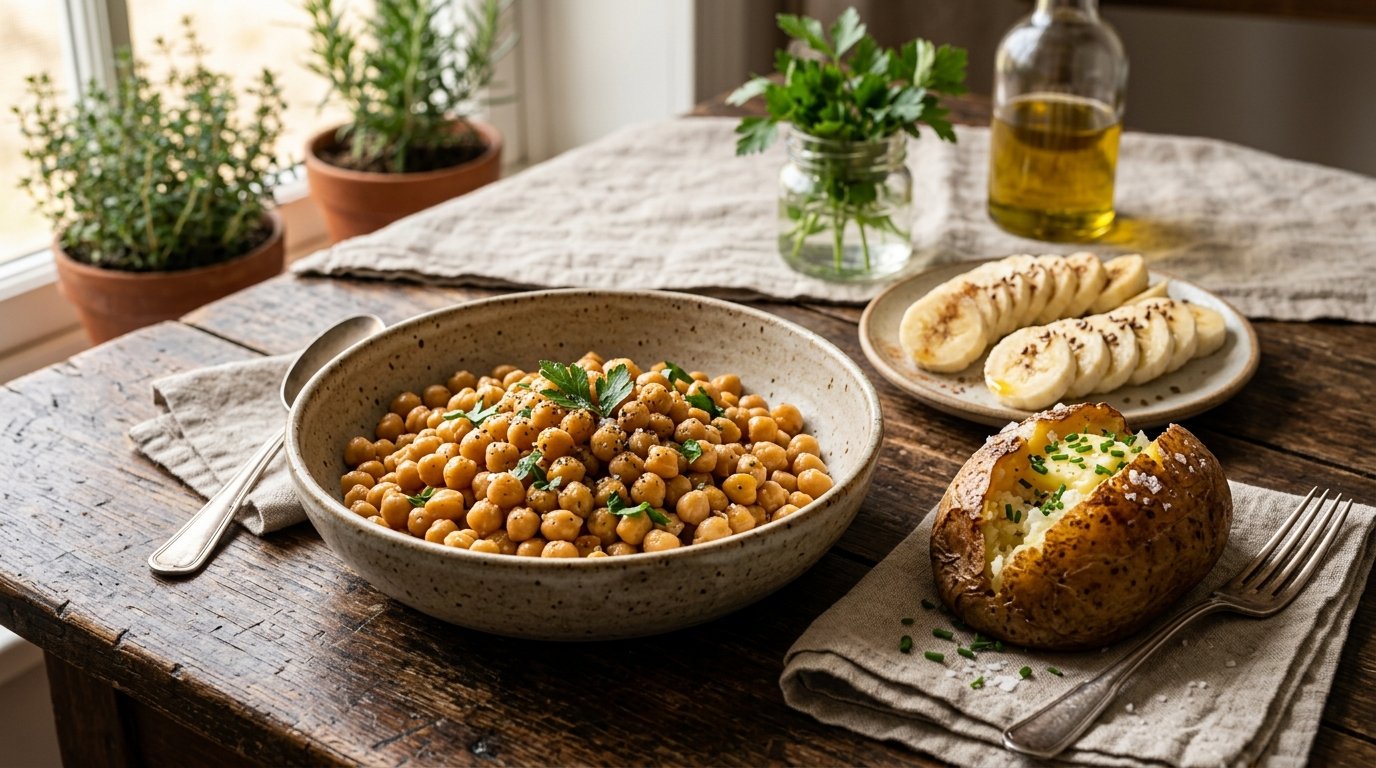
Consuming vitamin B6 rich chickpeas, potatoes, and bananas alongside folate and vitamin B12 optimizes the transsulfuration pathway, efficiently converting toxic homocysteine into beneficial cysteine.
6-Stage Biological Journey: Vitamin B6 (Pyridoxine)
Interactive pathway mapping Vitamin B6 (Pyridoxine) ingestion, digestive release, membrane transport, and cellular bio-utilization.
Pyridoxine Glucoside & Free Forms
Ingested from chickpeas, potatoes, bananas, and seeds as pyridoxine, pyridoxal, and plant pyridoxine-beta-glucoside.
Oral Mastication & Salivary Solubilization
High Whole Food Retention
Gastric Pass-Through
Best 100% Whole Food Plant-Based Sources of Vitamin B6 (Pyridoxine)
Top nutrient-dense plant foods ranked by % Daily Value per standard serving.
Chickpeas / Garbanzo (Cooked) →
Russet Potato with Skin (Baked)
Pistachios (Dry Roasted)
Yellow Banana (Fresh)
Spinach (Cooked) →
Sunflower Seeds (Dry Roasted)
Sweet Potato (Baked) →
Recommended Daily Allowance (RDA) & DRI Standards: Vitamin B6 (Pyridoxine)
Dietary Reference Intakes (DRI) across human life stages established by the National Academies of Sciences.
| Life Stage Bracket | Requirement Target | Type | Upper Limit (UL) | Visual Scale |
|---|---|---|---|---|
| Pediatric / Children | Dietary Whole Foods | AI | 100 mg / day (Sensory Neuropathy Safety Ceiling) | |
| Adolescents (14–18 years) | Age-Appropriate Intake | AI | 100 mg / day (Sensory Neuropathy Safety Ceiling) | |
| Adult Male (19+ years) | 1.3 – 1.7 mg / day (Adult Male) / 1.3 – 1.5 mg / day (Adult Female) | AI | 100 mg / day (Sensory Neuropathy Safety Ceiling) | |
| Adult Female (19+ years) | 1.3 – 1.7 mg / day (Adult Male) / 1.3 – 1.5 mg / day (Adult Female) | AI | 100 mg / day (Sensory Neuropathy Safety Ceiling) | |
| Pregnancy (19+ years) | 1.3 – 1.7 mg / day (Adult Male) / 1.3 – 1.5 mg / day (Adult Female) | AI | 100 mg / day (Sensory Neuropathy Safety Ceiling) | |
| Lactation (19+ years) | 1.3 – 1.7 mg / day (Adult Male) / 1.3 – 1.5 mg / day (Adult Female) | AI | 100 mg / day (Sensory Neuropathy Safety Ceiling) | |
| Optimal Therapeutic Target | Enhanced Dietary Target | AI | 100 mg / day (Sensory Neuropathy Safety Ceiling) |
100% Daily Value Achievement Combinations: Vitamin B6 (Pyridoxine)
Practical whole-food meal pairings to hit 100% of your daily Vitamin B6 (Pyridoxine) requirement effortlessly.
1 Serving Chickpeas / Garbanzo (Cooked)
Prepared Simmered for maximum retention.
1 Serving Russet Potato with Skin (Baked) + Pistachios (Dry Roasted)
Combined meal pairing for optimal Vitamin B6 (Pyridoxine) density.
Pistachios (Dry Roasted) + Yellow Banana (Fresh)
Diverse whole-food combination across two meal windows.
5-Stage Deficiency Progression Timeline: Vitamin B6 (Pyridoxine)
Clinical timeline tracing tissue depletion from early asymptomatic bio-depletion to overt pathology for Vitamin B6 (Pyridoxine). Educational deficiency progression model
Biochemical Biomarkers
- Plasma PLP < 10 nmol/L; plasma homocysteine elevates; impaired GABA and serotonin decarboxylation.
Clinical Symptoms
- Irritability, microcytic anemia, cheilosis, impaired immune response.
100% WFPB Therapeutic Protocol
Incorporate 2.0 – 5.0 mg daily dietary B6 from whole plant sources.
Interactive Toxicity & Tolerable Upper Intake Level (UL): Vitamin B6 (Pyridoxine)
Drag the slider to evaluate biological safety margins, upper intake ceilings, and toxicity thresholds for Vitamin B6 (Pyridoxine).
1.3 – 1.7 mg / day
2.0 – 25 mg / day
100 mg / day (Sensory Neuropathy Safety Ceiling)
> 300 mg / day (Chronic High Dose Supplement)
✅ Optimal Bio-Physiological Baseline (100% RDA)
Chronic high-dose synthetic pyridoxine supplements (> 200-500 mg/day) can cause sensory peripheral neuropathy (ataxia and numbness). Whole food plant B6 carries zero neuropathy risk.
Vitamin B6 (Pyridoxine) Reference Calculator
Estimate your daily Vitamin B6 (Pyridoxine) reference target using established Dietary Reference Intakes and relevant life-stage factors.
7-Day WFPB Meal Planner & Macro Balancer: Vitamin B6 (Pyridoxine)
Scientifically calculated 100% plant-based meal plan optimized for Vitamin B6 (Pyridoxine) density and bio-absorption.
Yellow Banana & Pistachio Oatmeal Bowl
Chickpea Hummus & Spinach Wrap with Potatoes
Baked Russet Potato Stuffed with Steamed Greens
Dry Roasted Pistachios & Sunflower Seeds
Categorized 100% WFPB Shopping List: Vitamin B6 (Pyridoxine)
Interactive grocery checklist organized by plant food category to hit your weekly Vitamin B6 (Pyridoxine) targets.
🛒 Fresh Produce
🛒 Legumes & Plant Proteins
🛒 Root Veggies & Pantry
Research & Evidence Intelligence Dashboard: Vitamin B6 (Pyridoxine)
Human clinical trial meta-analyses, publication trends, and consensus confidence grades for Vitamin B6 (Pyridoxine).
10-Year Publication Trend: Vitamin B6 (Pyridoxine) (2015 – 2024)
Official Scientific Research Authorities: Vitamin B6 (Pyridoxine)
Verified data sources establishing international dietary standards and clinical recommendations for Vitamin B6 (Pyridoxine).
USDA FoodData Central
VerifiedStandard Reference analytical database for 100% whole plant food micronutrient density.
NIH Office of Supplements
VerifiedNational Institutes of Health official DRI intake tables and deficiency research.
World Health Organization
VerifiedWHO/FAO expert consultation on human vitamin and mineral requirements.
NASEM Food & Nutrition
VerifiedNational Academies of Sciences evaluation of tolerable upper intake levels (UL).
Vitamin B6 (Pyridoxine) Knowledge Graph Explorer
Explore multi-dimensional entity connections linking Vitamin B6 (Pyridoxine) to plant food matrices, physiological functions, and health outcomes.
Frequently Asked Questions: Vitamin B6 (Pyridoxine)
Peer-reviewed answers to common questions regarding Vitamin B6 (Pyridoxine) bioavailability, absorption, and safety.
What is Vitamin B6 (Pyridoxine) and why is it essential?
Vitamin B6 is a water-soluble vitamin that forms Pyridoxal 5′-Phosphate (PLP), an obligate coenzyme for over 100 enzymes involved in amino acid transamination, neurotransmitter synthesis, and heme production.
What are the best whole food plant-based sources of Vitamin B6?
Top plant sources include cooked chickpeas (65% DV per cup), baked russet potatoes (31% DV per medium potato), dry roasted pistachios (28% DV per oz), yellow bananas (25% DV), cooked spinach (26% DV per cup), and sunflower seeds (22% DV per oz).
How much Vitamin B6 do adult men and women need daily?
According to NIH DRI guidelines, adults aged 19–50 need 1.3 mg/day. For adults over 50, requirements increase to 1.7 mg/day for males and 1.5 mg/day for females. Pregnancy requires 1.9 mg/day and lactation 2.0 mg/day.
What is Pyridoxal 5′-Phosphate (PLP) and how is it synthesized in the body?
PLP is the biologically active coenzyme form of B6. Ingested pyridoxine is dephosphorylated in the gut, absorbed, and phosphorylated in the liver by pyridoxal kinase and pyridoxine 5′-phosphate oxidase (PNPO).
How does Vitamin B6 support serotonin, dopamine, and GABA production?
PLP is the required decarboxylase coenzyme for converting 5-HTP to serotonin, L-DOPA to dopamine, glutamate to GABA, and histidine to histamine.
What is Pyridoxine Glucoside and how does it affect bioavailability in plant foods?
Pyridoxine-beta-glucoside is a conjugated form of B6 found in plant foods (grains, legumes). Intestinal beta-glucosidase cleaves it, resulting in ~75%–85% overall bioavailability compared to free vitabased forms.
What causes B6-induced sensory neuropathy and what is the safety limit (UL)?
Chronic high-dose synthetic pyridoxine supplements (> 200–500 mg/day) can cause sensory peripheral neuropathy. The NIH/FNB established a safe Tolerable Upper Intake Level (UL) of 100 mg/day for adults.
How does Vitamin B6 assist in clearing toxic homocysteine?
PLP acts as an obligate coenzyme for cystathionine beta-synthase and cystathionine gamma-lyase, converting homocysteine into cysteine via the transsulfuration pathway.
What are the signs of Vitamin B6 deficiency?
Deficiency causes microcytic sideroblastic anemia (impaired heme synthesis), electroencephalographic abnormalities and confusion (GABA depletion), seborrheic dermatitis, and angular cheilitis.
Why are chickpeas one of the highest plant-based sources of Vitamin B6?
Chickpeas naturally concentrate high levels of bioavailable free pyridoxine within their legume seed coat, providing over 60% of the daily B6 requirement in a single cooked cup.
Peer-Reviewed Scientific References: Vitamin B6 (Pyridoxine)
Official clinical guidelines, NIH Dietary Reference Intakes, and peer-reviewed journal articles for Vitamin B6 (Pyridoxine).