

Vitamin B5 (Pantothenic Acid) Evidence Guide
Essential water-soluble micronutrient obligate for Coenzyme A (CoA) and acyl carrier protein (ACP) synthesis, driving beta-oxidation, citric acid cycle acetyl-CoA transfer, and steroid hormone formation.
Quick Scientific Facts: Vitamin B5 (Pantothenic Acid)
Key physiological targets, upper safety bounds, and bioavailability metrics.
Why Vitamin B5 (Pantothenic Acid) Matters
Coenzyme A (CoA) Precursor • Water-Soluble Vitamin B5
Pantothenic Acid (Vitamin B5) derives its name from the Greek pantothen ("from everywhere"), reflecting its ubiquitous distribution in biological matrices. B5 serves as the fundamental structural component of Coenzyme A (CoA) and acyl carrier protein (ACP). CoA is essential for transferring acetyl and acyl groups in cellular metabolism, enabling energy release from carbohydrates, fatty acids, and amino acids. Furthermore, CoA is mandatory for synthesizing cholesterol, steroid hormones, neurotransmitter acetylcholine, and heme.
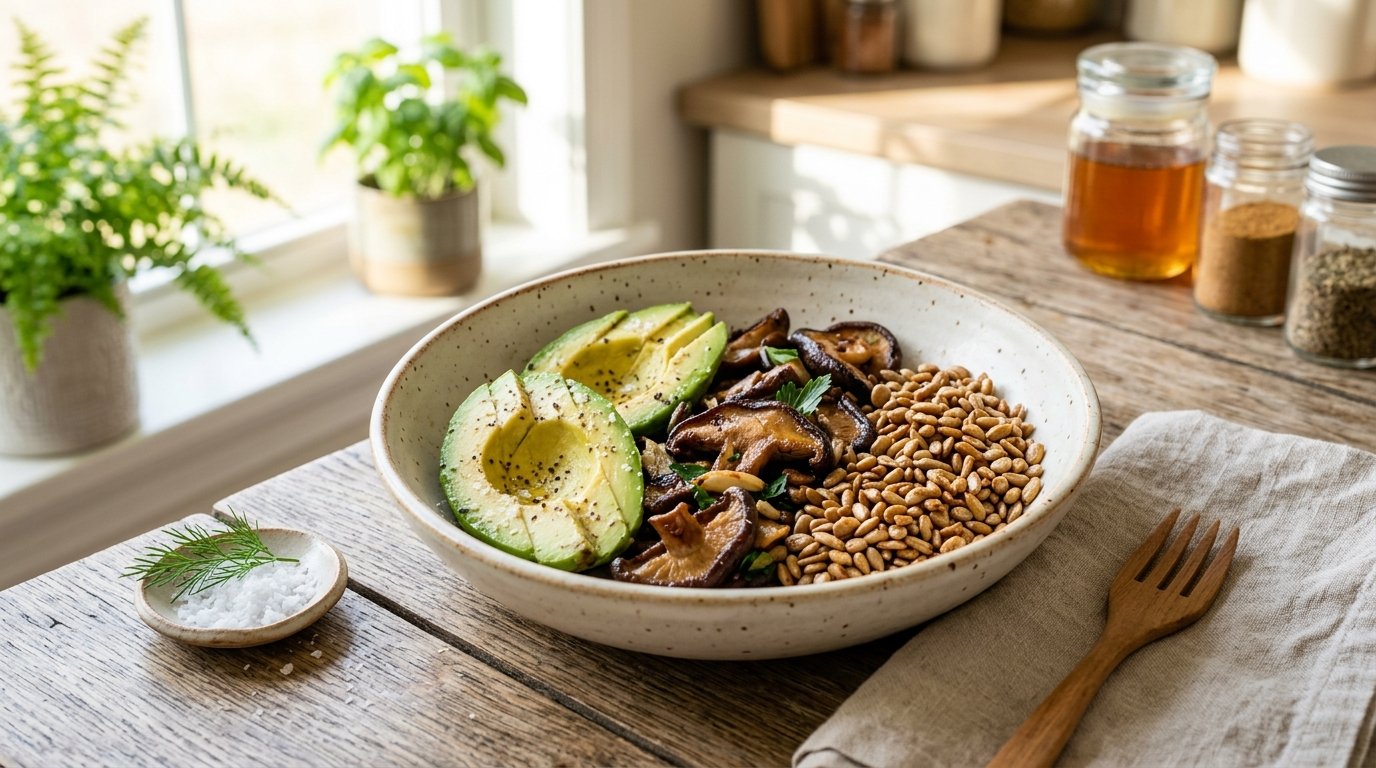
Combining pantothenic acid rich shiitake mushrooms, avocados, and sunflower seeds with cysteine-rich legumes supports intracellular pantetheine kinase activity during de novo CoA assembly.
6-Stage Biological Journey: Vitamin B5 (Pantothenic Acid)
Interactive pathway mapping Vitamin B5 (Pantothenic Acid) ingestion, digestive release, membrane transport, and cellular bio-utilization.
Bound CoA & Phosphopantetheine
Ingested from shiitake mushrooms, avocados, sunflower seeds, and legumes as bound CoA and free pantothenic acid.
Oral Mastication & Salivary Solubilization
High Whole Food Retention
Gastric Pass-Through
Best 100% Whole Food Plant-Based Sources of Vitamin B5 (Pantothenic Acid)
Top nutrient-dense plant foods ranked by % Daily Value per standard serving.
Shiitake Mushrooms (Cooked)
Sunflower Seeds (Dry Roasted)
Avocado (Fresh Hass) →
Sweet Potato (Baked) →
Lentils (Cooked) →
Fortified Soy Milk
Whole Grain Rolled Oats →
Recommended Daily Allowance (RDA) & DRI Standards: Vitamin B5 (Pantothenic Acid)
Dietary Reference Intakes (DRI) across human life stages established by the National Academies of Sciences.
| Life Stage Bracket | Requirement Target | Type | Upper Limit (UL) | Visual Scale |
|---|---|---|---|---|
| Pediatric / Children | Dietary Whole Foods | AI | Not Established (No Upper Ceiling Observed) | |
| Adolescents (14–18 years) | Age-Appropriate Intake | AI | Not Established (No Upper Ceiling Observed) | |
| Adult Male (19+ years) | 5 mg / day (Adult Adequate Intake AI) | AI | Not Established (No Upper Ceiling Observed) | |
| Adult Female (19+ years) | 5 mg / day (Adult Adequate Intake AI) | AI | Not Established (No Upper Ceiling Observed) | |
| Pregnancy (19+ years) | 5 mg / day (Adult Adequate Intake AI) | AI | Not Established (No Upper Ceiling Observed) | |
| Lactation (19+ years) | 5 mg / day (Adult Adequate Intake AI) | AI | Not Established (No Upper Ceiling Observed) | |
| Optimal Therapeutic Target | Enhanced Dietary Target | AI | Not Established (No Upper Ceiling Observed) |
100% Daily Value Achievement Combinations: Vitamin B5 (Pantothenic Acid)
Practical whole-food meal pairings to hit 100% of your daily Vitamin B5 (Pantothenic Acid) requirement effortlessly.
1 Serving Shiitake Mushrooms (Cooked)
Prepared Sauteed / Steam for maximum retention.
1 Serving Sunflower Seeds (Dry Roasted) + Avocado (Fresh Hass)
Combined meal pairing for optimal Vitamin B5 (Pantothenic Acid) density.
Avocado (Fresh Hass) + Sweet Potato (Baked)
Diverse whole-food combination across two meal windows.
5-Stage Deficiency Progression Timeline: Vitamin B5 (Pantothenic Acid)
Clinical timeline tracing tissue depletion from early asymptomatic bio-depletion to overt pathology for Vitamin B5 (Pantothenic Acid). Educational deficiency progression model
Biochemical Biomarkers
- Impaired acetylcholine neurotransmitter synthesis and reduced adrenal steroidogenesis.
Clinical Symptoms
- Irritability, sleep disturbances, abdominal cramps, paresthesia.
100% WFPB Therapeutic Protocol
Consume 5 – 10 mg daily dietary Pantothenate from whole plant sources.
Interactive Toxicity & Tolerable Upper Intake Level (UL): Vitamin B5 (Pantothenic Acid)
Drag the slider to evaluate biological safety margins, upper intake ceilings, and toxicity thresholds for Vitamin B5 (Pantothenic Acid).
5 – 7 mg / day (AI Baseline)
10 – 100 mg / day
Not Established
> 10,000 mg / day (Massive Oral Excess)
✅ Optimal Bio-Physiological Baseline (100% RDA)
Pantothenic acid has no established Tolerable Upper Intake Level (UL) as oral excess is rapidly cleared by renal excretion, with extreme high doses (> 10g) causing mild osmotic diarrhea.
Vitamin B5 (Pantothenic Acid) Reference Calculator
Estimate your daily Vitamin B5 (Pantothenic Acid) reference target using established Dietary Reference Intakes and relevant life-stage factors.
7-Day WFPB Meal Planner & Macro Balancer: Vitamin B5 (Pantothenic Acid)
Scientifically calculated 100% plant-based meal plan optimized for Vitamin B5 (Pantothenic Acid) density and bio-absorption.
Fortified Soy Milk Oats with Sunflower Seeds & Berries
Sauteed Shiitake Mushroom & Avocado Whole Wheat Wrap
Baked Sweet Potato & Lentil Bowl with Greens
Toasted Sunflower Seeds with Sea Salt
Categorized 100% WFPB Shopping List: Vitamin B5 (Pantothenic Acid)
Interactive grocery checklist organized by plant food category to hit your weekly Vitamin B5 (Pantothenic Acid) targets.
🛒 Fresh Produce
🛒 Legumes & Plant Proteins
🛒 Grains & Pantry
Research & Evidence Intelligence Dashboard: Vitamin B5 (Pantothenic Acid)
Human clinical trial meta-analyses, publication trends, and consensus confidence grades for Vitamin B5 (Pantothenic Acid).
10-Year Publication Trend: Vitamin B5 (Pantothenic Acid) (2015 – 2024)
Official Scientific Research Authorities: Vitamin B5 (Pantothenic Acid)
Verified data sources establishing international dietary standards and clinical recommendations for Vitamin B5 (Pantothenic Acid).
USDA FoodData Central
VerifiedStandard Reference analytical database for 100% whole plant food micronutrient density.
NIH Office of Supplements
VerifiedNational Institutes of Health official DRI intake tables and deficiency research.
World Health Organization
VerifiedWHO/FAO expert consultation on human vitamin and mineral requirements.
NASEM Food & Nutrition
VerifiedNational Academies of Sciences evaluation of tolerable upper intake levels (UL).
Vitamin B5 (Pantothenic Acid) Knowledge Graph Explorer
Explore multi-dimensional entity connections linking Vitamin B5 (Pantothenic Acid) to plant food matrices, physiological functions, and health outcomes.
Frequently Asked Questions: Vitamin B5 (Pantothenic Acid)
Peer-reviewed answers to common questions regarding Vitamin B5 (Pantothenic Acid) bioavailability, absorption, and safety.
What is Vitamin B5 (Pantothenic Acid) and why is it essential?
Pantothenic Acid (Vitamin B5) is a water-soluble vitamin that serves as the building block for Coenzyme A (CoA). CoA is essential for carbohydrate, lipid, and protein energy metabolism.
What are the best whole food plant-based sources of Vitamin B5?
Top plant sources include cooked shiitake mushrooms (104% DV per cup), dry roasted sunflower seeds (40% DV per oz), fresh avocado (42% DV per medium fruit), baked sweet potato (20% DV), cooked lentils (26% DV per cup), and fortified soy milk (22% DV per cup).
How much Pantothenic Acid do adults need daily?
The Adequate Intake (AI) for adults (19+ years) is 5 mg/day for both males and females. Recommended intake increases during pregnancy (6 mg/day) and lactation (7 mg/day).
What is the biological role of Coenzyme A (CoA) in cellular metabolism?
Coenzyme A forms thioester bonds with acyl groups, forming acetyl-CoA. Acetyl-CoA delivers carbon atoms to the citric acid cycle for ATP generation, lipid synthesis, and steroid hormone formation.
How is Pantothenic Acid absorbed in the small intestine?
Pantothenic acid is absorbed in the jejunum via the Sodium-Dependent Multivitamin Transporter (SMVT encoded by SLC5A6), which also transports biotin and alpha-lipoic acid.
Does cooking destroy Pantothenic Acid in whole foods?
Pantothenic acid is moderately sensitive to heat and acid/alkali conditions. Steaming or baking retains up to 70%–80% of pantothenate compared to extensive boiling.
What is "Burning Feet Syndrome" and how does it relate to B5 deficiency?
Burning Feet Syndrome is the classic clinical sign of severe B5 deficiency, characterized by painful burning paresthesia in the feet due to distal peripheral nerve demyelination.
Is there a Tolerable Upper Intake Level (UL) for Vitamin B5?
No UL has been established for Vitamin B5 because no toxic effects have been observed from high oral intakes from food or supplements.
Why are Shiitake mushrooms exceptionally rich in Vitamin B5?
Fungi naturally concentrate free pantothenic acid and bound phosphopantetheine coenzymes within their cellular fruiting bodies, making shiitake mushrooms one of the highest plant sources.
How does B5 support adrenal function and stress response?
Coenzyme A is an obligate substrate for synthesizing cholesterol precursors in adrenal cortex cells, supporting the production of cortisol and stress-adapted steroid hormones.
Peer-Reviewed Scientific References: Vitamin B5 (Pantothenic Acid)
Official clinical guidelines, NIH Dietary Reference Intakes, and peer-reviewed journal articles for Vitamin B5 (Pantothenic Acid).