

Vitamin B3 (Niacin) Evidence Guide
Essential water-soluble micronutrient precursor for nicotinamide adenine dinucleotide (NAD⁺ and NADPH) coenzymes, essential for mitochondrial ATP generation, poly(ADP-ribose) polymerase DNA repair, and sirtuin longevity pathways.
Quick Scientific Facts: Vitamin B3 (Niacin)
Key physiological targets, upper safety bounds, and bioavailability metrics.
Why Vitamin B3 (Niacin) Matters
Nicotinamide Adenine Dinucleotide (NAD⁺ / NADPH) • Water-Soluble B3
Niacin (Vitamin B3, encompassing nicotinic acid and nicotinamide) is the dietary precursor for the vital pyridine nucleotide coenzymes NAD⁺ (nicotinamide adenine dinucleotide) and NADPH. NAD⁺ acts as an electron acceptor in glycolysis, pyruvate oxidation, and the citric acid cycle, while NADPH provides reducing equivalents for anabolic lipid synthesis and antioxidant defense. Furthermore, NAD⁺ serves as an obligate substrate for PARP DNA repair enzymes and sirtuin histone deacetylases, linking niacin nutrition to genomic stability and cellular longevity.
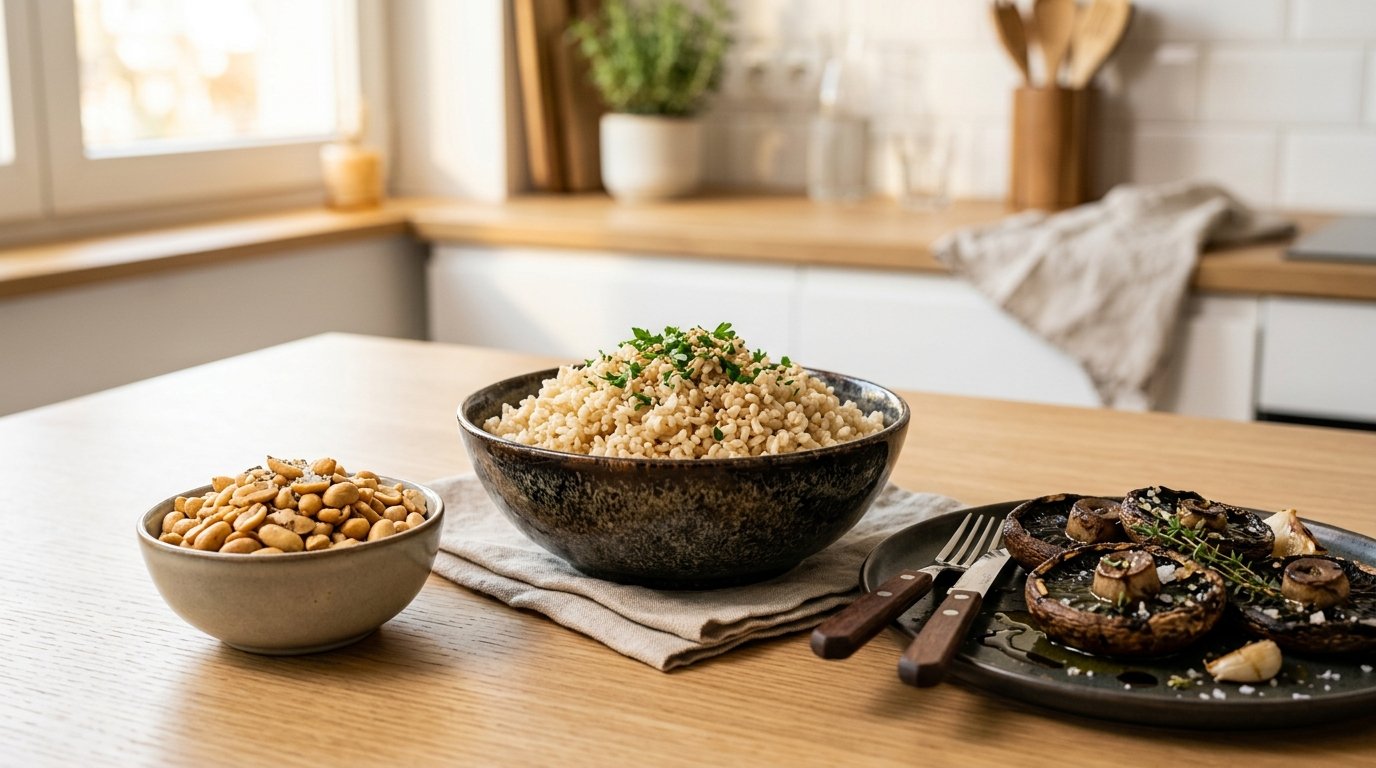
Pairing niacin-dense peanuts and mushrooms with vitamin B6 and riboflavin rich foods supports endogenous conversion of dietary tryptophan to niacin (where 60 mg tryptophan yields 1 mg Niacin Equivalent).
6-Stage Biological Journey: Vitamin B3 (Niacin)
Interactive pathway mapping Vitamin B3 (Niacin) ingestion, digestive release, membrane transport, and cellular bio-utilization.
Nicotinic Acid, Nicotinamide & Tryptophan
Ingested from peanuts, mushrooms, brown rice, and seeds as free nicotinic acid, nicotinamide, and protein-bound tryptophan.
Oral Mastication & Salivary Solubilization
High Whole Food Retention
Gastric Pass-Through
Best 100% Whole Food Plant-Based Sources of Vitamin B3 (Niacin)
Top nutrient-dense plant foods ranked by % Daily Value per standard serving.
Peanuts (Dry Roasted)
Portobello Mushrooms (Grilled)
Brown Rice (Cooked Whole Grain) →
Green Peas (Cooked)
Avocado (Fresh Hass) →
Firm Tofu (Organic Soy)
Sunflower Seeds (Dry Roasted)
Recommended Daily Allowance (RDA) & DRI Standards: Vitamin B3 (Niacin)
Dietary Reference Intakes (DRI) across human life stages established by the National Academies of Sciences.
| Life Stage Bracket | Requirement Target | Type | Upper Limit (UL) | Visual Scale |
|---|---|---|---|---|
| Pediatric / Children | Dietary Whole Foods | AI | 35 mg NE / day (Synthetic Supplemental Flushing Ceiling) | |
| Adolescents (14–18 years) | Age-Appropriate Intake | AI | 35 mg NE / day (Synthetic Supplemental Flushing Ceiling) | |
| Adult Male (19+ years) | 16 mg NE / day (Adult Male) / 14 mg NE / day (Adult Female) | AI | 35 mg NE / day (Synthetic Supplemental Flushing Ceiling) | |
| Adult Female (19+ years) | 16 mg NE / day (Adult Male) / 14 mg NE / day (Adult Female) | AI | 35 mg NE / day (Synthetic Supplemental Flushing Ceiling) | |
| Pregnancy (19+ years) | 16 mg NE / day (Adult Male) / 14 mg NE / day (Adult Female) | AI | 35 mg NE / day (Synthetic Supplemental Flushing Ceiling) | |
| Lactation (19+ years) | 16 mg NE / day (Adult Male) / 14 mg NE / day (Adult Female) | AI | 35 mg NE / day (Synthetic Supplemental Flushing Ceiling) | |
| Optimal Therapeutic Target | Enhanced Dietary Target | AI | 35 mg NE / day (Synthetic Supplemental Flushing Ceiling) |
100% Daily Value Achievement Combinations: Vitamin B3 (Niacin)
Practical whole-food meal pairings to hit 100% of your daily Vitamin B3 (Niacin) requirement effortlessly.
1 Serving Peanuts (Dry Roasted)
Prepared Dry Roasted for maximum retention.
1 Serving Portobello Mushrooms (Grilled) + Brown Rice (Cooked Whole Grain)
Combined meal pairing for optimal Vitamin B3 (Niacin) density.
Brown Rice (Cooked Whole Grain) + Green Peas (Cooked)
Diverse whole-food combination across two meal windows.
5-Stage Deficiency Progression Timeline: Vitamin B3 (Niacin)
Clinical timeline tracing tissue depletion from early asymptomatic bio-depletion to overt pathology for Vitamin B3 (Niacin). Educational deficiency progression model
Biochemical Biomarkers
- Urinary Niacin metabolites absent; impaired PARP DNA repair and mitochondrial ATP generation.
Clinical Symptoms
- Dermatitis on sun-exposed skin, bright red glossitis, anxiety, indigestion.
100% WFPB Therapeutic Protocol
Consume 20 – 50 mg daily dietary Niacin Equivalents from plant foods.
Interactive Toxicity & Tolerable Upper Intake Level (UL): Vitamin B3 (Niacin)
Drag the slider to evaluate biological safety margins, upper intake ceilings, and toxicity thresholds for Vitamin B3 (Niacin).
14 – 18 mg NE / day
20 – 100 mg / day
35 mg NE / day (Supplemental Flushing Ceiling)
> 1,000 mg / day (High Synthetic Dose)
✅ Optimal Bio-Physiological Baseline (100% RDA)
High-dose synthetic nicotinic acid supplements (> 30-50 mg) cause transient prostaglandin-mediated vasodilation (niacin flush). Whole food plant niacin carries zero risk of flushing.
Vitamin B3 (Niacin) Reference Calculator
Estimate your daily Vitamin B3 (Niacin) reference target using established Dietary Reference Intakes and relevant life-stage factors.
7-Day WFPB Meal Planner & Macro Balancer: Vitamin B3 (Niacin)
Scientifically calculated 100% plant-based meal plan optimized for Vitamin B3 (Niacin) density and bio-absorption.
Peanut Butter & Banana Oats Bowl
Grilled Portobello Mushroom & Brown Rice Bowl
Sauteed Tofu & Green Peas with Peanut Sauce
Fresh Avocado Slices & Sunflower Seeds
Categorized 100% WFPB Shopping List: Vitamin B3 (Niacin)
Interactive grocery checklist organized by plant food category to hit your weekly Vitamin B3 (Niacin) targets.
🛒 Fresh Produce
🛒 Legumes & Plant Proteins
🛒 Whole Grains & Pantry
Research & Evidence Intelligence Dashboard: Vitamin B3 (Niacin)
Human clinical trial meta-analyses, publication trends, and consensus confidence grades for Vitamin B3 (Niacin).
10-Year Publication Trend: Vitamin B3 (Niacin) (2015 – 2024)
Official Scientific Research Authorities: Vitamin B3 (Niacin)
Verified data sources establishing international dietary standards and clinical recommendations for Vitamin B3 (Niacin).
USDA FoodData Central
VerifiedStandard Reference analytical database for 100% whole plant food micronutrient density.
NIH Office of Supplements
VerifiedNational Institutes of Health official DRI intake tables and deficiency research.
World Health Organization
VerifiedWHO/FAO expert consultation on human vitamin and mineral requirements.
NASEM Food & Nutrition
VerifiedNational Academies of Sciences evaluation of tolerable upper intake levels (UL).
Vitamin B3 (Niacin) Knowledge Graph Explorer
Explore multi-dimensional entity connections linking Vitamin B3 (Niacin) to plant food matrices, physiological functions, and health outcomes.
Frequently Asked Questions: Vitamin B3 (Niacin)
Peer-reviewed answers to common questions regarding Vitamin B3 (Niacin) bioavailability, absorption, and safety.
What is Vitamin B3 (Niacin) and why is it vital for metabolism?
Niacin (Vitamin B3) is the obligate precursor for NAD⁺ and NADPH coenzymes. NAD⁺ transfers electrons in ATP energy production, while NADPH drives antioxidant defense and lipid synthesis.
What are the best whole food plant-based sources of Vitamin B3?
Top plant sources include dry roasted peanuts (24% DV per oz), grilled portobello mushrooms (39% DV per cup), cooked brown rice (33% DV per cup), green peas (20% DV per cup), avocado (16% DV), and firm tofu (15% DV per cup).
How much Niacin do adult men and women need daily?
According to NIH DRI guidelines, adult males require 16 mg Niacin Equivalents (NE)/day and adult females require 14 mg NE/day. Requirements increase during pregnancy (18 mg NE/day) and lactation (17 mg NE/day).
What is a Niacin Equivalent (NE) and how does Tryptophan convert to Niacin?
One Niacin Equivalent (NE) equals 1 mg of niacin or 60 mg of dietary tryptophan. The liver synthesizes niacin endogenously from tryptophan using Vitamin B6 and Riboflavin as cofactors.
How is Niacin absorbed in the gastrointestinal tract?
Nicotinic acid and nicotinamide are absorbed rapidly in the stomach and small intestine via sodium-dependent carrier-mediated active transport at low concentrations and passive diffusion at higher doses.
What causes the "Niacin Flush" and does whole food niacin cause it?
Niacin flush is a harmless prostaglandin-mediated vasodilation caused by high doses of synthetic nicotinic acid (>30-50 mg). Niacin naturally present in whole plant foods never causes flushing.
What are the classic clinical symptoms of Pellagra (B3 deficiency)?
Pellagra is characterized by the classic "3 Ds": photosensitive Dermatitis (Casal necklace), Diarrhea from GI mucosal atrophy, and Dementia with encephalopathy.
How does NAD⁺ connect Niacin to DNA repair and Sirtuin longevity pathways?
NAD⁺ is consumed as a substrate by PARP enzymes to repair damaged DNA single strands and by SIRT1-SIRT7 deacetylases to regulate gene expression and mitochondrial biogenesis.
Is there a Tolerable Upper Intake Level (UL) for Vitamin B3?
The UL for adults is set at 35 mg NE/day for synthetic supplemental forms to prevent flushing. There is no UL for naturally occurring niacin from whole plant foods.
Why is nixtamalization of corn important for niacin bioavailability?
Traditional nixtamalization (soaking corn in alkaline limewater) liberates bound niacytin from hemicellulose, converting unabsorbable bound niacin into free bioavailable nicotinic acid.
Peer-Reviewed Scientific References: Vitamin B3 (Niacin)
Official clinical guidelines, NIH Dietary Reference Intakes, and peer-reviewed journal articles for Vitamin B3 (Niacin).