

Vitamin B2 (Riboflavin) Evidence Guide
Essential water-soluble cofactor forming flavin mononucleotide (FMN) and flavin adenine dinucleotide (FAD) coenzymes, driving mitochondrial electron transport and cellular oxidation-reduction reactions.
Quick Scientific Facts: Vitamin B2 (Riboflavin)
Key physiological targets, upper safety bounds, and bioavailability metrics.
Why Vitamin B2 (Riboflavin) Matters
Flavin Adenine Dinucleotide (FAD) & FMN • Water-Soluble B2
Riboflavin (Vitamin B2) functions as the essential precursor for flavin mononucleotide (FMN) and flavin adenine dinucleotide (FAD), coenzymes that mediate critical oxidation-reduction reactions across human metabolism. FAD and FMN serve as electron carriers in Complexes I and II of the mitochondrial respiratory chain, fatty acid beta-oxidation, the citric acid cycle, and tryptophan-to-niacin conversion. Furthermore, riboflavin-dependent glutathione reductase maintains cellular antioxidant capacity by recycling reduced glutathione.
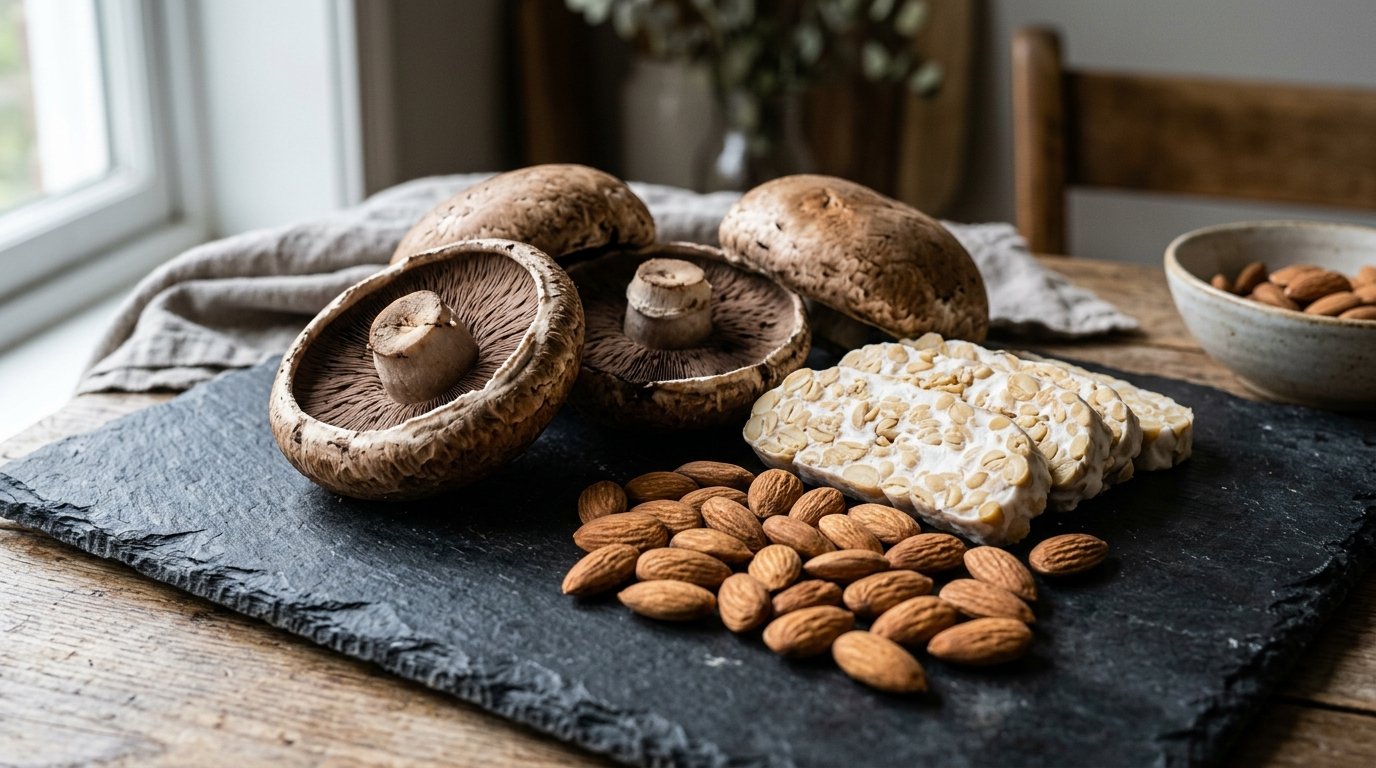
Consuming riboflavin-dense dark leafy greens and mushrooms alongside dietary fats (avocado, nuts) enhances intestinal flavin solubilization and enterocyte carrier transport efficiency.
6-Stage Biological Journey: Vitamin B2 (Riboflavin)
Interactive pathway mapping Vitamin B2 (Riboflavin) ingestion, digestive release, membrane transport, and cellular bio-utilization.
FAD & FMN Protein Complexes
Ingested from mushrooms, fermented tempeh, fortified soy milk, and leafy greens bound to dietary proteins.
Oral Mastication & Salivary Solubilization
High Whole Food Retention
Gastric Pass-Through
Best 100% Whole Food Plant-Based Sources of Vitamin B2 (Riboflavin)
Top nutrient-dense plant foods ranked by % Daily Value per standard serving.
Tempeh (Fermented Soy)
Portobello Mushrooms (Grilled)
Fortified Soy Milk
Spinach (Cooked) →
Beet Greens (Cooked)
Almonds (Raw Whole) →
Nutritional Yeast (Unfortified)
Recommended Daily Allowance (RDA) & DRI Standards: Vitamin B2 (Riboflavin)
Dietary Reference Intakes (DRI) across human life stages established by the National Academies of Sciences.
| Life Stage Bracket | Requirement Target | Type | Upper Limit (UL) | Visual Scale |
|---|---|---|---|---|
| Pediatric / Children | Dietary Whole Foods | AI | Not Established (No Upper Ceiling Observed) | |
| Adolescents (14–18 years) | Age-Appropriate Intake | AI | Not Established (No Upper Ceiling Observed) | |
| Adult Male (19+ years) | 1.3 mg / day (Adult Male) / 1.1 mg / day (Adult Female) | AI | Not Established (No Upper Ceiling Observed) | |
| Adult Female (19+ years) | 1.3 mg / day (Adult Male) / 1.1 mg / day (Adult Female) | AI | Not Established (No Upper Ceiling Observed) | |
| Pregnancy (19+ years) | 1.3 mg / day (Adult Male) / 1.1 mg / day (Adult Female) | AI | Not Established (No Upper Ceiling Observed) | |
| Lactation (19+ years) | 1.3 mg / day (Adult Male) / 1.1 mg / day (Adult Female) | AI | Not Established (No Upper Ceiling Observed) | |
| Optimal Therapeutic Target | Enhanced Dietary Target | AI | Not Established (No Upper Ceiling Observed) |
100% Daily Value Achievement Combinations: Vitamin B2 (Riboflavin)
Practical whole-food meal pairings to hit 100% of your daily Vitamin B2 (Riboflavin) requirement effortlessly.
1 Serving Tempeh (Fermented Soy)
Prepared Steam / Pan-Searing for maximum retention.
1 Serving Portobello Mushrooms (Grilled) + Fortified Soy Milk
Combined meal pairing for optimal Vitamin B2 (Riboflavin) density.
Fortified Soy Milk + Spinach (Cooked)
Diverse whole-food combination across two meal windows.
5-Stage Deficiency Progression Timeline: Vitamin B2 (Riboflavin)
Clinical timeline tracing tissue depletion from early asymptomatic bio-depletion to overt pathology for Vitamin B2 (Riboflavin). Educational deficiency progression model
Biochemical Biomarkers
- EGRAC > 1.40; impaired conversion of Vitamin B6 to PLP and tryptophan to niacin.
Clinical Symptoms
- Angular cheilitis, glossitis, stomatitis, seborrheic dermatitis.
100% WFPB Therapeutic Protocol
Consume 1.5 – 3.0 mg daily whole-food and fortified plant riboflavin.
Interactive Toxicity & Tolerable Upper Intake Level (UL): Vitamin B2 (Riboflavin)
Drag the slider to evaluate biological safety margins, upper intake ceilings, and toxicity thresholds for Vitamin B2 (Riboflavin).
1.1 – 1.6 mg / day
2.0 – 10 mg / day
Not Established
> 400 mg / day (High Migraine Dose)
✅ Optimal Bio-Physiological Baseline (100% RDA)
Riboflavin has no established Tolerable Upper Intake Level (UL) due to strict intestinal RFVT carrier saturation and rapid renal clearance (producing harmless bright yellow urine).
Vitamin B2 (Riboflavin) Reference Calculator
Estimate your daily Vitamin B2 (Riboflavin) reference target using established Dietary Reference Intakes and relevant life-stage factors.
7-Day WFPB Meal Planner & Macro Balancer: Vitamin B2 (Riboflavin)
Scientifically calculated 100% plant-based meal plan optimized for Vitamin B2 (Riboflavin) density and bio-absorption.
Fortified Soy Milk Smoothie with Spinach & Almonds
Grilled Portobello & Tempeh Salad with Greens
Steamed Beet Greens & Sauteed Tofu Bowl
Raw Whole Almonds & Nutritional Yeast Sprinkled
Categorized 100% WFPB Shopping List: Vitamin B2 (Riboflavin)
Interactive grocery checklist organized by plant food category to hit your weekly Vitamin B2 (Riboflavin) targets.
🛒 Fresh Produce
🛒 Legumes & Plant Proteins
🛒 Yeast & Pantry
Research & Evidence Intelligence Dashboard: Vitamin B2 (Riboflavin)
Human clinical trial meta-analyses, publication trends, and consensus confidence grades for Vitamin B2 (Riboflavin).
10-Year Publication Trend: Vitamin B2 (Riboflavin) (2015 – 2024)
Official Scientific Research Authorities: Vitamin B2 (Riboflavin)
Verified data sources establishing international dietary standards and clinical recommendations for Vitamin B2 (Riboflavin).
USDA FoodData Central
VerifiedStandard Reference analytical database for 100% whole plant food micronutrient density.
NIH Office of Supplements
VerifiedNational Institutes of Health official DRI intake tables and deficiency research.
World Health Organization
VerifiedWHO/FAO expert consultation on human vitamin and mineral requirements.
NASEM Food & Nutrition
VerifiedNational Academies of Sciences evaluation of tolerable upper intake levels (UL).
Vitamin B2 (Riboflavin) Knowledge Graph Explorer
Explore multi-dimensional entity connections linking Vitamin B2 (Riboflavin) to plant food matrices, physiological functions, and health outcomes.
Frequently Asked Questions: Vitamin B2 (Riboflavin)
Peer-reviewed answers to common questions regarding Vitamin B2 (Riboflavin) bioavailability, absorption, and safety.
What is Vitamin B2 (Riboflavin) and why is it essential?
Riboflavin (Vitamin B2) is a water-soluble vitamin required to synthesize FMN and FAD coenzymes. These coenzymes drive mitochondrial respiration, cellular energy production, and glutathione antioxidant defense.
What are the best whole food plant-based sources of Vitamin B2?
Top plant sources include fermented tempeh (45% DV per cup), grilled portobello mushrooms (36% DV per cup), fortified soy milk (38% DV per cup), cooked spinach (33% DV per cup), beet greens (32% DV per cup), and raw almonds (25% DV per oz).
How much Riboflavin do adults need daily?
NIH Dietary Reference Intakes state that adult males require 1.3 mg/day and adult females require 1.1 mg/day. Requirements increase during pregnancy (1.4 mg/day) and lactation (1.6 mg/day).
Why does Riboflavin cause bright yellow urine?
Riboflavin has a natural intense yellow-green fluorescent pigment. Excess water-soluble riboflavin consumed beyond cellular saturation is safely excreted via renal filtration, coloring urine harmlessly.
How is Riboflavin absorbed in the gut?
Riboflavin is absorbed in the proximal small intestine via three specialized Riboflavin Transporters: RFVT1 (SLC52A1), RFVT2 (SLC52A2), and RFVT3 (SLC52A3).
Is Riboflavin sensitive to light or heat during cooking?
Riboflavin is stable under heat but highly sensitive to ultraviolet (UV) light. Storing riboflavin-containing plant milks and grains in opaque or light-blocking containers prevents photodegradation.
What are the classic symptoms of Ariboflavinosis (B2 deficiency)?
Symptoms include angular cheilitis (cracks at mouth corners), swollen magenta tongue (glossitis), seborrheic dermatitis, and ocular light sensitivity with corneal vascularization.
How does Vitamin B2 interact with Vitamin B6 and Niacin synthesis?
FAD and FMN coenzymes are obligate cofactors for pyridoxine 5-phosphate oxidase (converting B6 to active PLP) and kynurenine 3-monooxygenase (converting tryptophan to niacin).
Is there a Tolerable Upper Intake Level (UL) for Vitamin B2?
No UL has been set for Riboflavin due to limited active transporter absorption capacity and rapid urinary excretion, showing no adverse effects even at high intake levels.
Why are fermented soy foods like tempeh exceptionally rich in Vitamin B2?
Fungal fermentation by Rhizopus oligosporus during tempeh production synthesizes additional bioavailable riboflavin, significantly increasing its concentration compared to unfermented soybeans.
Peer-Reviewed Scientific References: Vitamin B2 (Riboflavin)
Official clinical guidelines, NIH Dietary Reference Intakes, and peer-reviewed journal articles for Vitamin B2 (Riboflavin).