Vitamin B1 (Thiamin) Evidence Guide
Essential water-soluble micronutrient that acts as an obligate coenzyme (thiamin diphosphate) for transketolase and pyruvate dehydrogenase, driving mitochondrial ATP energy cleavage from plant carbohydrates.
Quick Scientific Facts: Vitamin B1 (Thiamin)
Key physiological targets, upper safety bounds, and bioavailability metrics.
Why Vitamin B1 (Thiamin) Matters
Thiamin Diphosphate (TDP) • Water-Soluble Vitamin B1
Thiamin (Vitamin B1) serves as an indispensable coenzyme precursor in central cellular energy metabolism. Once absorbed, thiamin is rapidly phosphorylated into thiamin diphosphate (TDP, also known as thiamin pyrophosphate), which acts as an essential cofactor for mitochondrial enzymes including pyruvate dehydrogenase, alpha-ketoglutarate dehydrogenase, and cytosolic transketolase. These pathway nodes link glycolysis to the citric acid cycle and pentose phosphate pathway, rendering thiamin essential for neuronal impulse transmission, cardiac bioenergetics, and cellular NADPH generation.
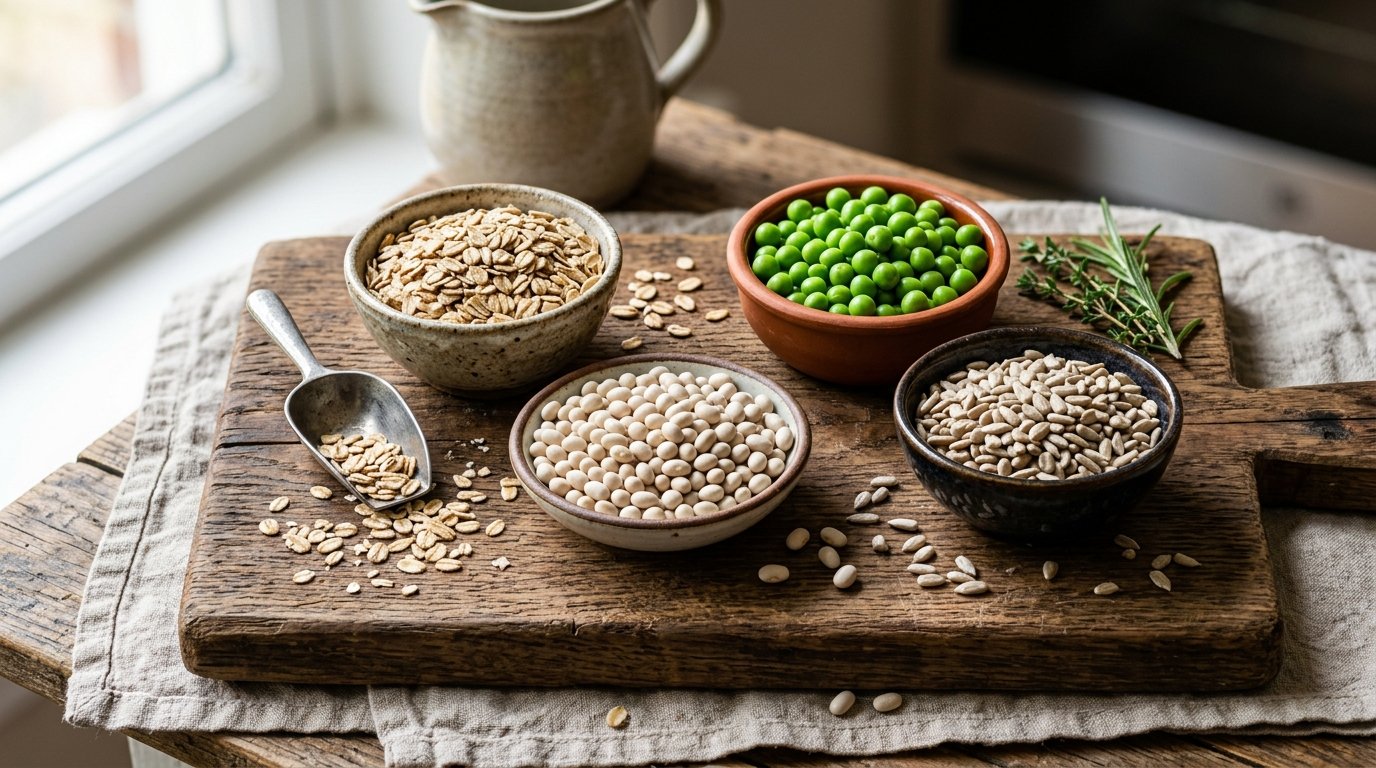
Pairing thiamin-dense legumes and whole grains with magnesium-rich seeds (sunflower, pumpkin) optimizes cellular TDP synthesis, as magnesium acts as an obligate cofactor for thiamin pyrophosphokinase.
6-Stage Biological Journey: Vitamin B1 (Thiamin)
Interactive pathway mapping Vitamin B1 (Thiamin) ingestion, digestive release, membrane transport, and cellular bio-utilization.
Free Thiamin & TDP
Ingested from whole plant matrices (sunflower seeds, legumes, whole grains) as free thiamin and bound thiamin diphosphate.
Oral Mastication & Salivary Solubilization
High Whole Food Retention
Gastric Pass-Through
Best 100% Whole Food Plant-Based Sources of Vitamin B1 (Thiamin)
Top nutrient-dense plant foods ranked by % Daily Value per standard serving.
Sunflower Seeds (Dry Roasted)
Green Peas (Cooked)
Navy Beans (Cooked)
Black Beans (Cooked) →
Whole Grain Rolled Oats →
Lentils (Cooked) →
Firm Tofu (Organic Soy)
Nutritional Yeast (Unfortified)
Recommended Daily Allowance (RDA) & DRI Standards: Vitamin B1 (Thiamin)
Dietary Reference Intakes (DRI) across human life stages established by the National Academies of Sciences.
| Life Stage Bracket | Requirement Target | Type | Upper Limit (UL) | Visual Scale |
|---|---|---|---|---|
| Pediatric / Children | Dietary Whole Foods | AI | Not Established (No Toxic Ceiling Observed) | |
| Adolescents (14–18 years) | Age-Appropriate Intake | AI | Not Established (No Toxic Ceiling Observed) | |
| Adult Male (19+ years) | 1.2 mg / day (Adult Male) / 1.1 mg / day (Adult Female) | AI | Not Established (No Toxic Ceiling Observed) | |
| Adult Female (19+ years) | 1.2 mg / day (Adult Male) / 1.1 mg / day (Adult Female) | AI | Not Established (No Toxic Ceiling Observed) | |
| Pregnancy (19+ years) | 1.2 mg / day (Adult Male) / 1.1 mg / day (Adult Female) | AI | Not Established (No Toxic Ceiling Observed) | |
| Lactation (19+ years) | 1.2 mg / day (Adult Male) / 1.1 mg / day (Adult Female) | AI | Not Established (No Toxic Ceiling Observed) | |
| Optimal Therapeutic Target | Enhanced Dietary Target | AI | Not Established (No Toxic Ceiling Observed) |
100% Daily Value Achievement Combinations: Vitamin B1 (Thiamin)
Practical whole-food meal pairings to hit 100% of your daily Vitamin B1 (Thiamin) requirement effortlessly.
1 Serving Sunflower Seeds (Dry Roasted)
Prepared Raw / Light Toast for maximum retention.
1 Serving Green Peas (Cooked) + Navy Beans (Cooked)
Combined meal pairing for optimal Vitamin B1 (Thiamin) density.
Navy Beans (Cooked) + Black Beans (Cooked)
Diverse whole-food combination across two meal windows.
5-Stage Deficiency Progression Timeline: Vitamin B1 (Thiamin)
Clinical timeline tracing tissue depletion from early asymptomatic bio-depletion to overt pathology for Vitamin B1 (Thiamin). Educational deficiency progression model
Biochemical Biomarkers
- Erythrocyte transketolase activation coefficient (ETAC) increases above 15%; intracellular pyruvate accumulates.
Clinical Symptoms
- Irritability, peripheral weakness, calf muscle tenderness, insomnia.
100% WFPB Therapeutic Protocol
Incorporate 1.5 – 3.0 mg daily whole-food plant thiamin sources.
Interactive Toxicity & Tolerable Upper Intake Level (UL): Vitamin B1 (Thiamin)
Drag the slider to evaluate biological safety margins, upper intake ceilings, and toxicity thresholds for Vitamin B1 (Thiamin).
1.1 – 1.4 mg / day
1.5 – 10 mg / day
Not Established
> 50 mg / day (Parenteral High Dose)
✅ Optimal Bio-Physiological Baseline (100% RDA)
Oral dietary thiamin from whole plant foods has no established Tolerable Upper Intake Level (UL) due to active carrier saturation limiting excessive intestinal transport.
Vitamin B1 (Thiamin) Reference Calculator
Estimate your daily Vitamin B1 (Thiamin) reference target using established Dietary Reference Intakes and relevant life-stage factors.
7-Day WFPB Meal Planner & Macro Balancer: Vitamin B1 (Thiamin)
Scientifically calculated 100% plant-based meal plan optimized for Vitamin B1 (Thiamin) density and bio-absorption.
Rolled Oats Bowl with Sunflower Seeds & Berries
Black Bean & Green Pea Salad with Lemon Dressing
Navy Bean & Steamed Tofu Stew over Brown Rice
Toasted Sunflower Seeds with Nutritional Yeast
Categorized 100% WFPB Shopping List: Vitamin B1 (Thiamin)
Interactive grocery checklist organized by plant food category to hit your weekly Vitamin B1 (Thiamin) targets.
🛒 Fresh Produce
🛒 Legumes & Plant Proteins
🛒 Whole Grains & Yeast
Research & Evidence Intelligence Dashboard: Vitamin B1 (Thiamin)
Human clinical trial meta-analyses, publication trends, and consensus confidence grades for Vitamin B1 (Thiamin).
10-Year Publication Trend: Vitamin B1 (Thiamin) (2015 – 2024)
Official Scientific Research Authorities: Vitamin B1 (Thiamin)
Verified data sources establishing international dietary standards and clinical recommendations for Vitamin B1 (Thiamin).
USDA FoodData Central
VerifiedStandard Reference analytical database for 100% whole plant food micronutrient density.
NIH Office of Supplements
VerifiedNational Institutes of Health official DRI intake tables and deficiency research.
World Health Organization
VerifiedWHO/FAO expert consultation on human vitamin and mineral requirements.
NASEM Food & Nutrition
VerifiedNational Academies of Sciences evaluation of tolerable upper intake levels (UL).
Vitamin B1 (Thiamin) Knowledge Graph Explorer
Explore multi-dimensional entity connections linking Vitamin B1 (Thiamin) to plant food matrices, physiological functions, and health outcomes.
Frequently Asked Questions: Vitamin B1 (Thiamin)
Peer-reviewed answers to common questions regarding Vitamin B1 (Thiamin) bioavailability, absorption, and safety.
What is Vitamin B1 (Thiamin) and why is it essential for plant-based diets?
Thiamin (Vitamin B1) is an essential water-soluble vitamin required to convert carbohydrates and branched-chain amino acids into mitochondrial ATP energy. On a plant-based diet, thiamin is naturally abundant in sunflower seeds, legumes, whole oats, and green peas.
What are the best 100% whole food plant-based sources of Vitamin B1?
Top plant sources include dry roasted sunflower seeds (34% DV per oz), cooked green peas (38% DV per cup), cooked navy beans (35% DV per cup), cooked black beans (34% DV per cup), firm tofu (33% DV per cup), rolled oats (31% DV per cup), and lentils (28% DV per cup).
How much Thiamin do adult men and women need daily?
According to NIH Dietary Reference Intakes (DRI), adult males (19+ years) require 1.2 mg/day, while adult females require 1.1 mg/day. Requirements increase during pregnancy (1.4 mg/day) and lactation (1.4 mg/day).
What is the active coenzyme form of Vitamin B1 in cellular metabolism?
The active coenzyme form is Thiamin Diphosphate (TDP, also known as thiamin pyrophosphate). TDP acts as an obligate cofactor for mitochondrial pyruvate dehydrogenase, alpha-ketoglutarate dehydrogenase, and cytosolic transketolase.
How is Thiamin absorbed in the small intestine?
Free thiamin is absorbed primarily in the duodenum and jejunum via two specialized high-affinity carrier-mediated transporters: ThTr1 (SLC19A2) and ThTr2 (SLC19A3). At high intake concentrations, passive diffusion also occurs.
Does cooking or heat destroy Vitamin B1 in whole grains and legumes?
Thiamin is heat-sensitive and water-soluble. Boiling in large amounts of water can leach 20%–40% of thiamin into the cooking liquid. Steaming, simmering, or consuming cooking broths helps maximize retention.
What are the early signs and symptoms of Thiamin deficiency?
Early symptoms include muscle fatigue, calf tenderness, irritability, loss of appetite, and sleep disturbances. Prolonged deficiency can lead to dry beriberi (neuropathy) or wet beriberi (cardiovascular edema).
Are anti-thiamin factors in tea, coffee, or raw betel nuts significant?
Polyphenolic compounds (tannins) in heavy tea and coffee consumption can oxidize thiamin into an inactive form if consumed simultaneously with meals. Spacing tea and coffee 1 hour away from meals prevents interference.
Is there a Tolerable Upper Intake Level (UL) for Vitamin B1?
No Tolerable Upper Intake Level (UL) has been established for Vitamin B1 by the FNB/NIH because active intestinal carrier saturation prevents toxic accumulation, and excess thiamin is readily excreted in urine.
How do whole plant foods like sunflower seeds and beans compare to thiamin supplements?
Whole plant foods provide thiamin alongside dietary fiber, magnesium, potassium, and complementary B-complex vitamins that synergistically enhance cellular energy production and metabolic health.
Peer-Reviewed Scientific References: Vitamin B1 (Thiamin)
Official clinical guidelines, NIH Dietary Reference Intakes, and peer-reviewed journal articles for Vitamin B1 (Thiamin).