

Protein Evidence Guide
Essential macronutrient composed of 20 amino acids (including 9 indispensable) vital for muscle protein synthesis, enzymatic biocatalysis, immune antibody production, and cellular tissue architecture.
Quick Scientific Facts: Protein
Key physiological targets, upper safety bounds, and bioavailability metrics.
Why Protein Matters
Polypeptide Macro-Structure • 9 Essential Amino Acids
Proteins are linear polymers of 20 proteinogenic amino acids, of which 9 (histidine, isoleucine, leucine, lysine, methionine, phenylalanine, threonine, tryptophan, valine) are strictly indispensable. On a 100% whole-food plant-based diet, consuming diverse legumes, whole grains, nuts, and seeds provides an optimal amino acid pool with superior longevity outcomes compared to animal proteins high in sulfur-containing amino acids and advanced glycation end-products.
Consuming a variety of whole plant foods across the day (e.g. lysine-rich legumes with methionine-rich whole grains) optimizes amino acid pooling without needing protein combining in single meals.
6-Stage Biological Journey: Protein
Interactive pathway mapping Protein ingestion, digestive release, membrane transport, and cellular bio-utilization.
Whole Food Protein Matrix
Intact plant proteins are released during mastication alongside protective dietary fibers.
Oral Mastication & Salivary Solubilization
High Whole Food Retention
Gastric Pass-Through
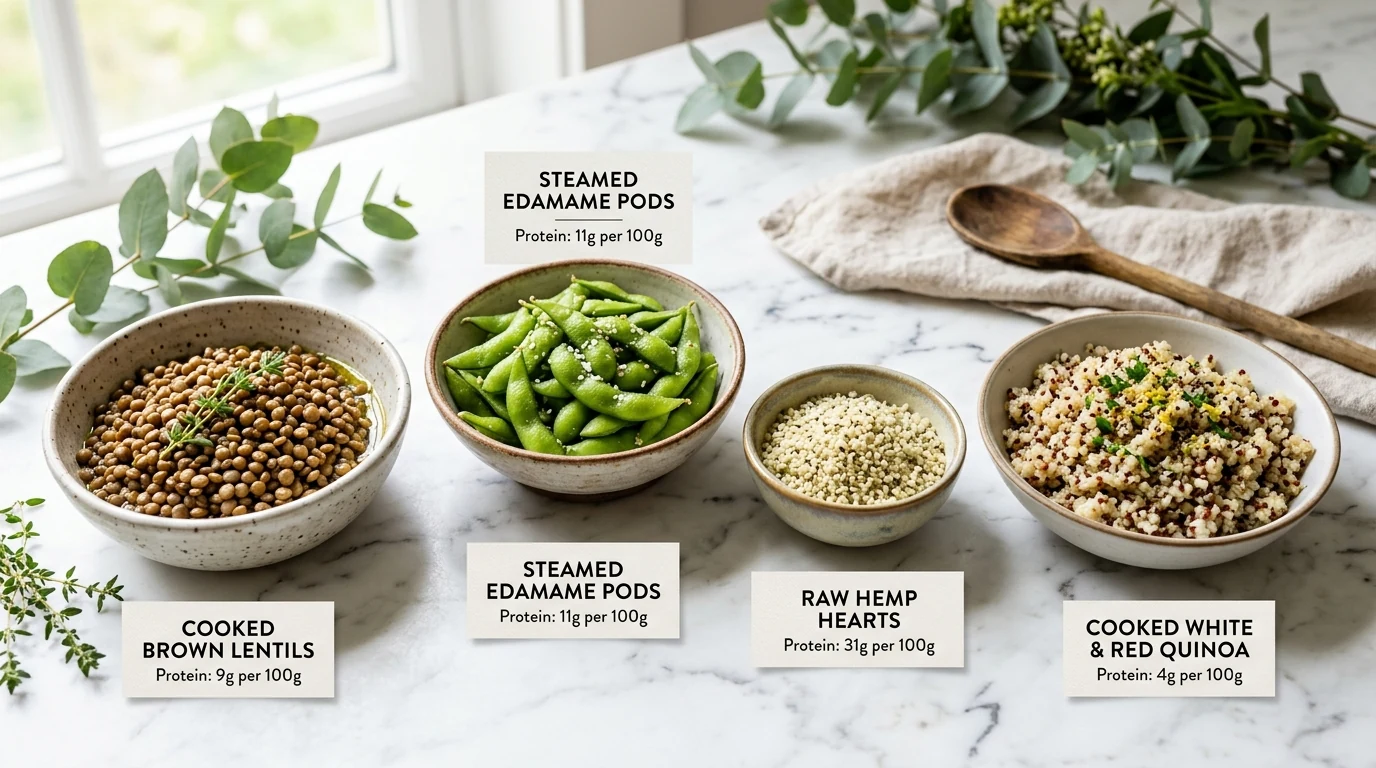
Best 100% Whole Food Plant-Based Sources of Protein
Top nutrient-dense plant foods ranked by % Daily Value per standard serving.
Cooked Tempeh
Cooked Brown Lentils →
Cooked Edamame →
Cooked Chickpeas →
Raw Hemp Seeds →
Cooked Quinoa →
Recommended Daily Allowance (RDA) & DRI Standards: Protein
Dietary Reference Intakes (DRI) across human life stages established by the National Academies of Sciences.
| Life Stage Bracket | Requirement Target | Type | Upper Limit (UL) | Visual Scale |
|---|---|---|---|---|
| Infants (0–12 months) | 9.1 – 11 g / day | AI | Not Established | |
| Children (1–8 years) | 13 – 19 g / day | RDA | Not Established | |
| Adolescents (14–18 years) | 52 g (M) / 46 g (F) | RDA | Not Established | |
| Adult Male (19+ years) | 56 g / day (0.8–1.2g/kg) | RDA | 3.5 g/kg safe upper limit | |
| Adult Female (19+ years) | 46 g / day (0.8–1.2g/kg) | RDA | 3.5 g/kg safe upper limit | |
| Pregnancy (19+ years) | 71 g / day (+25g add-on) | RDA | Not Established | |
| Lactation (19+ years) | 71 g / day (+25g add-on) | RDA | Not Established | |
| Athletic High Demand | 1.4 – 1.8 g / kg / day | RDA | 3.5 g/kg safe upper limit |
100% Daily Value Achievement Combinations: Protein
Practical whole-food meal pairings to hit 100% of your daily Protein requirement effortlessly.
1 Serving Cooked Tempeh
Prepared Steamed / Pan-Sauté for maximum retention.
1 Serving Cooked Brown Lentils + Cooked Edamame
Combined meal pairing for optimal Protein density.
Cooked Edamame + Cooked Chickpeas
Diverse whole-food combination across two meal windows.
5-Stage Deficiency Progression Timeline: Protein
Clinical timeline tracing tissue depletion from early asymptomatic bio-depletion to overt pathology for Protein. Educational deficiency progression model
Biochemical Biomarkers
- Plasma albumin 3.0–3.5 g/dL
- Elevated urinary 3-methylhistidine (muscle breakdown)
- Decreased IGF-1 levels
Clinical Symptoms
- Measurable reduction in lean muscle mass (sarcopenia)
- Hair thinning & brittle nails
- Mild immune vulnerability
100% WFPB Therapeutic Protocol
Target 1.2–1.6 g/kg daily with lentils, tofu, and hemp seeds.
Interactive Toxicity & Tolerable Upper Intake Level (UL): Protein
Drag the slider to evaluate biological safety margins, upper intake ceilings, and toxicity thresholds for Protein.
0.8 – 1.6 g / kg / day (50 – 110 g / day)
1.6 – 2.2 g / kg / day (Athletic High Demand)
Not Established for Whole Plant Foods
> 3.5 g / kg / day (Severe Glomerular Hyperfiltration)
✅ Optimal Bio-Physiological Baseline (100% RDA)
Intact whole-food plant proteins carry zero kidney disease risk in healthy individuals because natural plant fibers and alkaline ash protect renal hemodynamics.
Protein Reference Calculator
Estimate your daily Protein reference target using established Dietary Reference Intakes and relevant life-stage factors.
7-Day WFPB Meal Planner & Macro Balancer: Protein
Scientifically calculated 100% plant-based meal plan optimized for Protein density and bio-absorption.
Tofu Scramble with Spinach, Nutritional Yeast & Sprouted Toast
Warm Lentil, Quinoa & Roasted Veggie Buddha Bowl with Tahini
Hemp Seed & Blueberry Chia Protein Pudding
Marinated Baked Tempeh with Steamed Edamame & Brown Rice
Categorized 100% WFPB Shopping List: Protein
Interactive grocery checklist organized by plant food category to hit your weekly Protein targets.
🛒 High-Protein Legumes & Soy
🛒 Whole Grains & Seeds
Research & Evidence Intelligence Dashboard: Protein
Human clinical trial meta-analyses, publication trends, and consensus confidence grades for Protein.
No verified research data available
Clinical trials and meta-analyses for Protein are currently being indexed.
Official Scientific Research Authorities: Protein
Verified data sources establishing international dietary standards and clinical recommendations for Protein.
USDA FoodData Central
VerifiedStandard Reference analytical database for 100% whole plant food micronutrient density.
NIH Office of Supplements
VerifiedNational Institutes of Health official DRI intake tables and deficiency research.
World Health Organization
VerifiedWHO/FAO expert consultation on human vitamin and mineral requirements.
NASEM Food & Nutrition
VerifiedNational Academies of Sciences evaluation of tolerable upper intake levels (UL).
Protein Knowledge Graph Explorer
Explore multi-dimensional entity connections linking Protein to plant food matrices, physiological functions, and health outcomes.
Frequently Asked Questions: Protein
Peer-reviewed answers to common questions regarding Protein bioavailability, absorption, and safety.
Do plant proteins contain all 9 essential amino acids?
Yes. All whole plant foods contain all 20 amino acids, including all 9 essential ones. While the proportions differ (e.g. legumes are high in lysine and grains in methionine), a diverse 100% whole-food plant diet effortlessly fulfills all amino acid requirements.
Do I need to combine proteins in the same meal?
No. The American Academy of Nutrition and Dietetics confirms that the human body maintains an amino acid pool and combines proteins consumed throughout the day.
How much protein do strength athletes on a plant-based diet need?
Sports nutrition research recommends 1.4 to 1.8 grams per kilogram of body weight for plant-based strength and endurance athletes.
Is plant protein as bioavailable as animal protein?
Cooked and prepared plant proteins have a digestibility score of 85% to 95%. Whole-food processing methods like soaking, boiling, and sprouting neutralize phytates and maximize absorption.
Does high plant protein intake harm the kidneys?
No. Clinical studies show that plant protein does not induce the glomerular hyperfiltration and renal stress seen with high-dose animal protein.
Peer-Reviewed Scientific References: Protein
Official clinical guidelines, NIH Dietary Reference Intakes, and peer-reviewed journal articles for Protein.