

Lycopene Evidence Guide
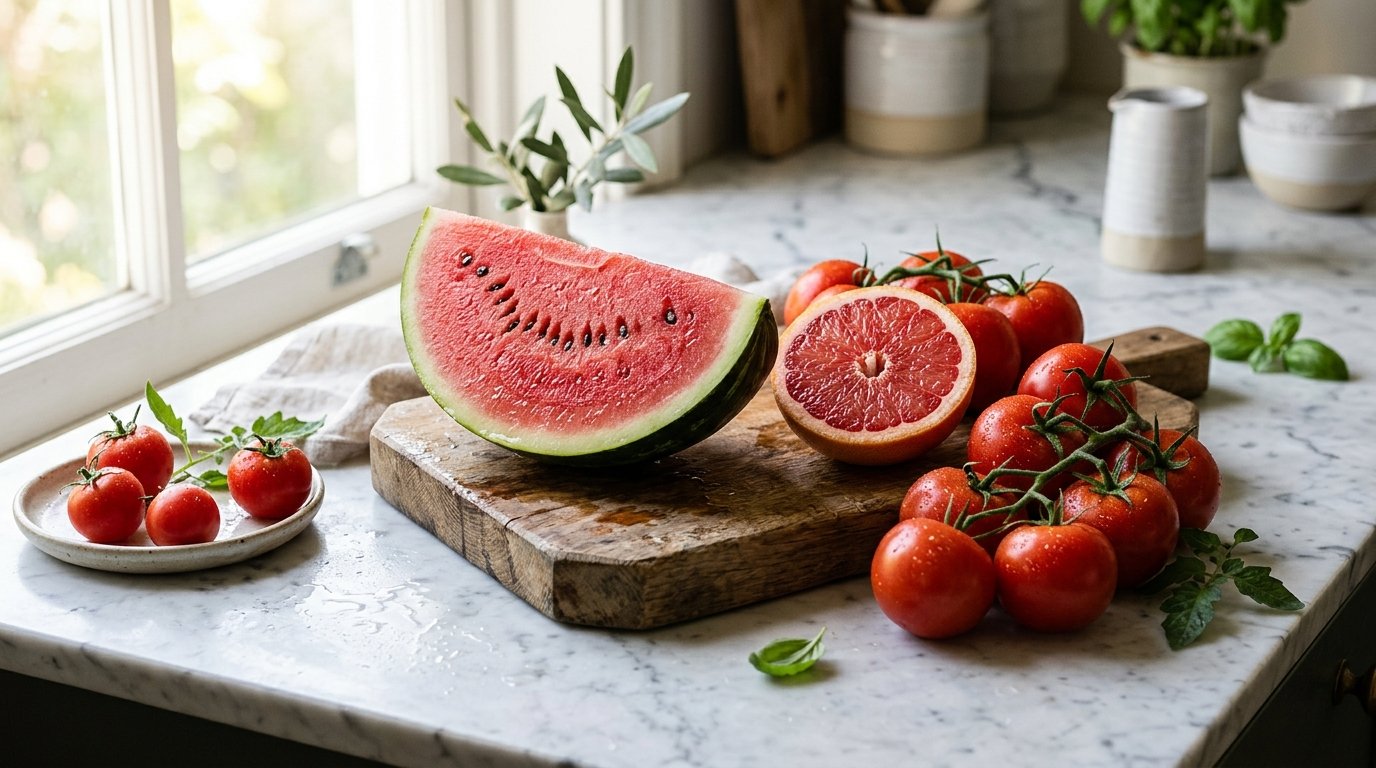
Potent acyclic carotenoid antioxidant responsible for the bright red color of tomatoes and watermelon, vital for singlet oxygen quenching, endothelial protection, and prostate cellular health.
Quick Scientific Facts: Lycopene
Key physiological targets, upper safety bounds, and bioavailability metrics.
Why Lycopene Matters
Acyclic Carotenoid Tetraterpene • Hydrocarbon Phytochemical (C40H56)
Lycopene is the most powerful singlet oxygen quencher among all natural carotenoids (2x greater than beta-carotene and 10x greater than alpha-tocopherol). It concentrates in human prostate, adrenal glands, liver, and skin, down-regulating pro-inflammatory IL-6 and TNF-alpha, inhibiting LDL oxidation, and reducing prostate and cardiovascular disease risk.
Thermal processing (cooking tomatoes into paste or sauce) isomerizes all-trans-lycopene into bioavailable cis-isomers, increasing gastrointestinal absorption by up to 300%. Pairing with healthy fats (olive or avocado) further enhances micellar uptake.
6-Stage Biological Journey: Lycopene
Interactive pathway mapping Lycopene ingestion, digestive release, membrane transport, and cellular bio-utilization.
Carotenoid-Protein Complex
Lycopene is released from the plant chromoplast matrix during chewing and gastric acid digestion.
Oral Mastication & Salivary Solubilization
High Whole Food Retention
Gastric Pass-Through
Best 100% Whole Food Plant-Based Sources of Lycopene
Top nutrient-dense plant foods ranked by % Daily Value per standard serving.
Cooked Tomato Paste
Sun-Dried Tomatoes
Cooked Tomato Puree
Fresh Watermelon
Pink Guava
Fresh Papaya
Recommended Daily Allowance (RDA) & DRI Standards: Lycopene
Dietary Reference Intakes (DRI) across human life stages established by the National Academies of Sciences.
| Life Stage Bracket | Requirement Target | Type | Upper Limit (UL) | Visual Scale |
|---|---|---|---|---|
| Pediatric / Children | Dietary Whole Foods | AI | Not Established (No clinical toxicity; non-toxic lycopenodermia at >75mg/day) | |
| Adolescents (14–18 years) | Age-Appropriate Intake | AI | Not Established (No clinical toxicity; non-toxic lycopenodermia at >75mg/day) | |
| Adult Male (19+ years) | 10 – 30 mg / day (Evidence-Based Daily Preventive Target) | AI | Not Established (No clinical toxicity; non-toxic lycopenodermia at >75mg/day) | |
| Adult Female (19+ years) | 10 – 30 mg / day (Evidence-Based Daily Preventive Target) | AI | Not Established (No clinical toxicity; non-toxic lycopenodermia at >75mg/day) | |
| Pregnancy (19+ years) | 10 – 30 mg / day (Evidence-Based Daily Preventive Target) | AI | Not Established (No clinical toxicity; non-toxic lycopenodermia at >75mg/day) | |
| Lactation (19+ years) | 10 – 30 mg / day (Evidence-Based Daily Preventive Target) | AI | Not Established (No clinical toxicity; non-toxic lycopenodermia at >75mg/day) | |
| Optimal Therapeutic Target | Enhanced Dietary Target | AI | Not Established (No clinical toxicity; non-toxic lycopenodermia at >75mg/day) |
100% Daily Value Achievement Combinations: Lycopene
Practical whole-food meal pairings to hit 100% of your daily Lycopene requirement effortlessly.
1 Serving Cooked Tomato Paste
Prepared Concentrated Paste for maximum retention.
1 Serving Sun-Dried Tomatoes + Cooked Tomato Puree
Combined meal pairing for optimal Lycopene density.
Cooked Tomato Puree + Fresh Watermelon
Diverse whole-food combination across two meal windows.
5-Stage Deficiency Progression Timeline: Lycopene
Clinical timeline tracing tissue depletion from early asymptomatic bio-depletion to overt pathology for Lycopene. Educational deficiency progression model
Biochemical Biomarkers
- Serum lycopene < 0.3 umol/L
- Elevated markers of LDL oxidation (ox-LDL)
- Increased prostatic stromal oxidative stress
Clinical Symptoms
- Elevated vulnerability to sunburn erythema
- Mild increase in systemic inflammatory tone
- Suboptimal endothelial flow dilation
100% WFPB Therapeutic Protocol
Target 15–25mg daily with cooked tomato dishes and watermelon.
Interactive Toxicity & Tolerable Upper Intake Level (UL): Lycopene
Drag the slider to evaluate biological safety margins, upper intake ceilings, and toxicity thresholds for Lycopene.
10 – 30 mg / day (From cooked tomato products, watermelon, guava)
20 – 45 mg / day (Targeted Cardiovascular & Prostate Support)
Not Established for Whole Foods
> 75 mg / day (Benign harmless skin pigmentation - lycopenodermia)
✅ Optimal Bio-Physiological Baseline (100% RDA)
Dietary lycopene from whole plant foods has zero toxicity. Excessive intake simply causes temporary orange skin coloring that resolves upon lowering intake.
Lycopene Reference Calculator
Estimate your daily Lycopene reference target using established Dietary Reference Intakes and relevant life-stage factors.
7-Day WFPB Meal Planner & Macro Balancer: Lycopene
Scientifically calculated 100% plant-based meal plan optimized for Lycopene density and bio-absorption.
Hydrating Watermelon, Mint & Chia Seed Bowl
Rich Tomato Basil Soup with Whole Grain Sourdough Toast
Sliced Fresh Guava or Papaya with Squeeze of Lime
Whole Wheat Pasta with Slow-Simmered Tomato Paste & Lentils
Categorized 100% WFPB Shopping List: Lycopene
Interactive grocery checklist organized by plant food category to hit your weekly Lycopene targets.
🛒 Lycopene Produce
🛒 Culinary Staples
Research & Evidence Intelligence Dashboard: Lycopene
Human clinical trial meta-analyses, publication trends, and consensus confidence grades for Lycopene.
No verified research data available
Clinical trials and meta-analyses for Lycopene are currently being indexed.
Official Scientific Research Authorities: Lycopene
Verified data sources establishing international dietary standards and clinical recommendations for Lycopene.
USDA FoodData Central
VerifiedStandard Reference analytical database for 100% whole plant food micronutrient density.
NIH Office of Supplements
VerifiedNational Institutes of Health official DRI intake tables and deficiency research.
World Health Organization
VerifiedWHO/FAO expert consultation on human vitamin and mineral requirements.
NASEM Food & Nutrition
VerifiedNational Academies of Sciences evaluation of tolerable upper intake levels (UL).
Lycopene Knowledge Graph Explorer
Explore multi-dimensional entity connections linking Lycopene to plant food matrices, physiological functions, and health outcomes.
Frequently Asked Questions: Lycopene
Peer-reviewed answers to common questions regarding Lycopene bioavailability, absorption, and safety.
Why is cooked tomato paste better for lycopene than raw tomatoes?
Cooking breaks down plant cell walls and converts trans-lycopene into the more bioavailable cis-isomer form, increasing absorption by up to 300%.
Does watermelon have as much lycopene as tomatoes?
Yes. Fresh watermelon contains approximately 40% more lycopene per gram than raw fresh tomatoes and is ready for absorption without cooking.
How does lycopene protect prostate health?
Lycopene concentrates in prostate epithelial tissue, where it quenches singlet oxygen, suppresses androgen-dependent signaling, and prevents oxidative DNA damage.
Can lycopene act as internal sunscreen for the skin?
Clinical trials demonstrate that consuming 16mg of dietary lycopene daily for 10–12 weeks reduces UV-induced skin erythema (sunburn) by up to 40%.
Do I need dietary fat to absorb lycopene?
Yes. Lycopene is fat-soluble. Consuming tomato dishes with a small amount of whole plant fats (olive, avocado, nuts) enhances intestinal micellization.
Peer-Reviewed Scientific References: Lycopene
Official clinical guidelines, NIH Dietary Reference Intakes, and peer-reviewed journal articles for Lycopene.