Iodine Evidence Guide
Essential trace mineral required for the synthesis of thyroid hormones thyroxine (T4) and triiodothyronine (T3), regulating metabolic rate, cellular respiration, and neurodevelopment.
Quick Scientific Facts: Iodine
Key physiological targets, upper safety bounds, and bioavailability metrics.
Why Iodine Matters
Iodide Ion (I⁻) • Essential Thyroid Hormone Constituent
Iodine is absorbed rapidly as iodide (I⁻) and actively concentrated into thyroid follicular cells via the Sodium-Iodide Symporter (NIS) to form thyroglobulin.
Pairing dietary iodine with adequate selenium protects thyroid follicular cells from hydrogen peroxide oxidative damage during thyroid peroxidase hormone synthesis.
6-Stage Biological Journey: Iodine
Interactive pathway mapping Iodine ingestion, digestive release, membrane transport, and cellular bio-utilization.
Iodide & Seaweed Matrix
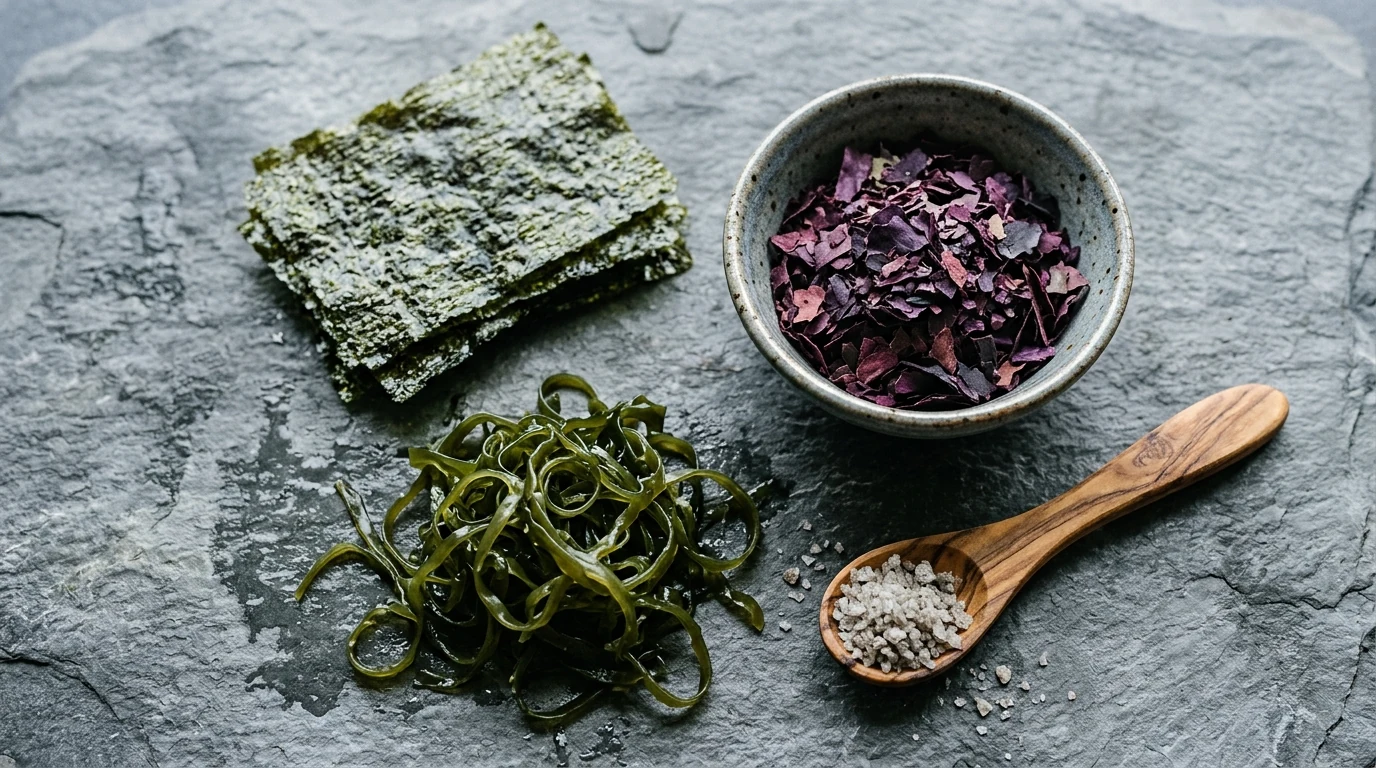
Ingested from nori seaweed, iodized salt, baked potatoes, & navy beans.
Oral Mastication & Salivary Solubilization
High Whole Food Retention
Gastric Pass-Through
Best 100% Whole Food Plant-Based Sources of Iodine
Top nutrient-dense plant foods ranked by % Daily Value per standard serving.
Cooked Nori Seaweed
Iodized Table Salt
Baked Potato with Skin
Cooked Navy Beans
Raw Organic Cranberries
Organic Prunes (Dried Plums)
Recommended Daily Allowance (RDA) & DRI Standards: Iodine
Dietary Reference Intakes (DRI) across human life stages established by the National Academies of Sciences.
| Life Stage Bracket | Requirement Target | Type | Upper Limit (UL) | Visual Scale |
|---|---|---|---|---|
| Pediatric / Children | Dietary Whole Foods | AI | 1,100 mcg / day | |
| Adolescents (14–18 years) | Age-Appropriate Intake | AI | 1,100 mcg / day | |
| Adult Male (19+ years) | 150 mcg / day (Adult RDA & FDA DV) | AI | 1,100 mcg / day | |
| Adult Female (19+ years) | 150 mcg / day (Adult RDA & FDA DV) | AI | 1,100 mcg / day | |
| Pregnancy (19+ years) | 150 mcg / day (Adult RDA & FDA DV) | AI | 1,100 mcg / day | |
| Lactation (19+ years) | 150 mcg / day (Adult RDA & FDA DV) | AI | 1,100 mcg / day | |
| Optimal Therapeutic Target | Enhanced Dietary Target | AI | 1,100 mcg / day |
100% Daily Value Achievement Combinations: Iodine
Practical whole-food meal pairings to hit 100% of your daily Iodine requirement effortlessly.
1 Serving Cooked Nori Seaweed
Prepared Dried Raw for maximum retention.
1 Serving Iodized Table Salt + Baked Potato with Skin
Combined meal pairing for optimal Iodine density.
Baked Potato with Skin + Cooked Navy Beans
Diverse whole-food combination across two meal windows.
5-Stage Deficiency Progression Timeline: Iodine
Clinical timeline tracing tissue depletion from early asymptomatic bio-depletion to overt pathology for Iodine. Educational deficiency progression model
Biochemical Biomarkers
- TSH stimulation causes thyroid follicular hypertrophy & gland enlargement.
Clinical Symptoms
- Visible neck swelling, dysphagia, hoarseness, hypothyroidism.
100% WFPB Therapeutic Protocol
150 mcg daily iodine repletion protocol.
Interactive Toxicity & Tolerable Upper Intake Level (UL): Iodine
Drag the slider to evaluate biological safety margins, upper intake ceilings, and toxicity thresholds for Iodine.
150 mcg / day
150 – 300 mcg / day
1,100 mcg / day
> 1,100 mcg / day
✅ Optimal Bio-Physiological Baseline (100% RDA)
Consuming verified iodized salt (1/4 tsp) or moderate nori seaweed is safe. Excess iodine (>1,100 mcg/day) from excessive kelp supplements can trigger iodine-induced hyperthyroidism.
Iodine Reference Calculator
Estimate your daily Iodine reference target using established Dietary Reference Intakes and relevant life-stage factors.
7-Day WFPB Meal Planner & Macro Balancer: Iodine
Scientifically calculated 100% plant-based meal plan optimized for Iodine density and bio-absorption.
Oatmeal Porridge Sprinkled with Dried Nori Flakes
Baked Potato & Navy Bean Salad with Cranberries
Nori-Wrapped Vegetable Rice Rolls
Handful of Organic Prunes & Fresh Cranberries
Categorized 100% WFPB Shopping List: Iodine
Interactive grocery checklist organized by plant food category to hit your weekly Iodine targets.
🛒 Pantry & Sea Vegetables
🛒 Fresh Produce & Legumes
Research & Evidence Intelligence Dashboard: Iodine
Human clinical trial meta-analyses, publication trends, and consensus confidence grades for Iodine.
10-Year Publication Trend: Iodine (2015 – 2024)
Official Scientific Research Authorities: Iodine
Verified data sources establishing international dietary standards and clinical recommendations for Iodine.
USDA FoodData Central
VerifiedStandard Reference analytical database for 100% whole plant food micronutrient density.
NIH Office of Supplements
VerifiedNational Institutes of Health official DRI intake tables and deficiency research.
World Health Organization
VerifiedWHO/FAO expert consultation on human vitamin and mineral requirements.
NASEM Food & Nutrition
VerifiedNational Academies of Sciences evaluation of tolerable upper intake levels (UL).
Iodine Knowledge Graph Explorer
Explore multi-dimensional entity connections linking Iodine to plant food matrices, physiological functions, and health outcomes.
Frequently Asked Questions: Iodine
Peer-reviewed answers to common questions regarding Iodine bioavailability, absorption, and safety.
What is the primary biological function of iodine in the human body?
Iodine is the essential component of thyroid hormones thyroxine (T4) and triiodothyronine (T3), which regulate basal metabolic rate, cellular oxygen consumption, and brain neurodevelopment.
What is the daily iodine requirement (RDA) for adults?
The adult RDA and FDA Daily Value baseline for iodine is 150 mcg/day. During pregnancy and lactation, requirements rise to 220 mcg/day and 290 mcg/day.
Can a 100% whole food plant-based diet provide adequate iodine?
Yes. Including verified iodized table salt (1/4 tsp provides 45 mcg), nori seaweed, baked potatoes with skin, and navy beans reliably meets daily requirements.
Why does seaweed iodine content vary significantly?
Iodine concentrations in sea vegetables depend on ocean region, species, and harvesting. Nori provides moderate iodine (~116 mcg per serving), whereas kelp (Kombu) contains extremely high levels that require cautious intake.
What are the symptoms of iodine deficiency?
Early symptoms include fatigue, weight gain, cold intolerance, and dry skin. Severe deficiency causes goiter (thyroid enlargement) and gestational cognitive impairment.
What is the upper safety limit (UL) for iodine?
The Tolerable Upper Intake Level (UL) for adults is 1,100 mcg/day from food and supplements.
How does the Sodium-Iodide Symporter (NIS) transport iodine?
The NIS protein actively transports iodide (I⁻) into thyroid cells against a 20- to 50-fold concentration gradient by co-transporting two sodium ions (Na⁺) per iodide ion.
Does cooking affect the iodine content of plant foods?
Boiling vegetables in large volumes of water can leach 20% to 40% of water-soluble iodine into discarded water. Steaming or baking potatoes retains 90%+ of natural iodine.
What is the relationship between iodine and selenium?
Selenium (via deiodinase enzymes) converts T4 to active T3, while glutathione peroxidase destroys excess hydrogen peroxide generated during iodine organification.
Which whole plant food delivers high iodine without excessive sodium?
Cooked nori seaweed sheets (116 mcg per serving) and baked whole potatoes with skin (60 mcg per potato) provide high plant iodine with minimal natural sodium.
Peer-Reviewed Scientific References: Iodine
Official clinical guidelines, NIH Dietary Reference Intakes, and peer-reviewed journal articles for Iodine.