

Choline Evidence Guide
Essential nutrient required for structural phosphatidylcholine cell membranes, acetylcholine neurotransmitter synthesis, hepatic VLDL lipotropic export, and betaine one-carbon methyl group metabolism.
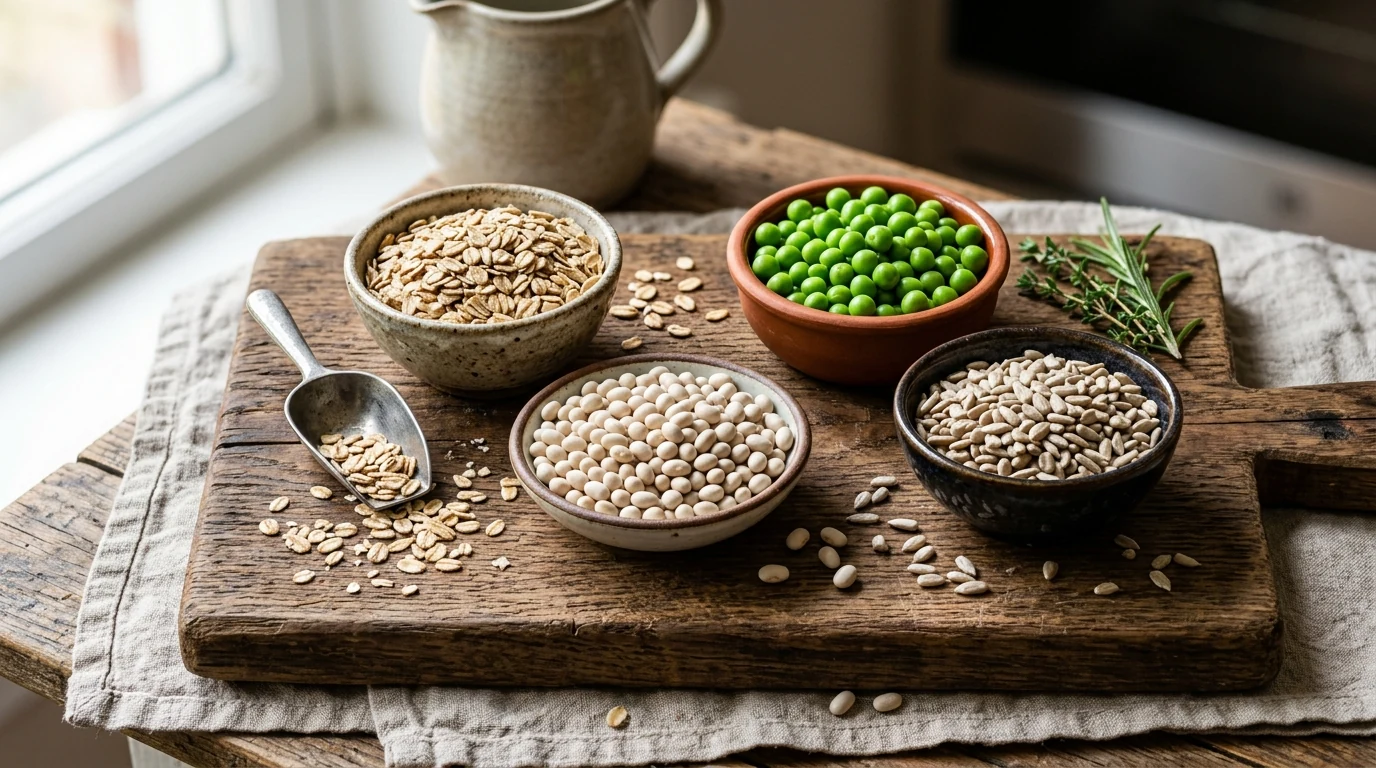
Quick Scientific Facts: Choline
Key physiological targets, upper safety bounds, and bioavailability metrics.
Why Choline Matters
Trimethyl-Ethanolamine • Essential Methyl Donor & Neurotransmitter Precursor
Choline is absorbed in the small intestine via organic cation transporters, converted to acetylcholine in cholinergic neurons, and oxidized to betaine in liver mitochondria.
Consuming choline-rich edamame, tofu, shiitake mushrooms, and cruciferous greens alongside folate (B9) and vitamin B12 optimizes one-carbon methyl group metabolism, lowering homocysteine.
6-Stage Biological Journey: Choline
Interactive pathway mapping Choline ingestion, digestive release, membrane transport, and cellular bio-utilization.
Soy & Fungi Phospholipid Matrix
Ingested as free choline & phosphatidylcholine from shiitake, edamame, tofu, kidney beans, & broccoli.
Oral Mastication & Salivary Solubilization
High Whole Food Retention
Gastric Pass-Through
Best 100% Whole Food Plant-Based Sources of Choline
Top nutrient-dense plant foods ranked by % Daily Value per standard serving.
Cooked Shiitake Mushrooms
Cooked Edamame (Soybeans) →
Organic Firm Tofu
Cooked Red Kidney Beans →
Cooked Organic Broccoli →
Cooked Brussels Sprouts
Recommended Daily Allowance (RDA) & DRI Standards: Choline
Dietary Reference Intakes (DRI) across human life stages established by the National Academies of Sciences.
| Life Stage Bracket | Requirement Target | Type | Upper Limit (UL) | Visual Scale |
|---|---|---|---|---|
| Pediatric / Children | Dietary Whole Foods | AI | 3,500 mg / day (3.5 g / day) | |
| Adolescents (14–18 years) | Age-Appropriate Intake | AI | 3,500 mg / day (3.5 g / day) | |
| Adult Male (19+ years) | 550 mg / day (Male AI) / 425 mg / day (Female AI) • 550 mg / day (FDA DV) | AI | 3,500 mg / day (3.5 g / day) | |
| Adult Female (19+ years) | 550 mg / day (Male AI) / 425 mg / day (Female AI) • 550 mg / day (FDA DV) | AI | 3,500 mg / day (3.5 g / day) | |
| Pregnancy (19+ years) | 550 mg / day (Male AI) / 425 mg / day (Female AI) • 550 mg / day (FDA DV) | AI | 3,500 mg / day (3.5 g / day) | |
| Lactation (19+ years) | 550 mg / day (Male AI) / 425 mg / day (Female AI) • 550 mg / day (FDA DV) | AI | 3,500 mg / day (3.5 g / day) | |
| Optimal Therapeutic Target | Enhanced Dietary Target | AI | 3,500 mg / day (3.5 g / day) |
100% Daily Value Achievement Combinations: Choline
Practical whole-food meal pairings to hit 100% of your daily Choline requirement effortlessly.
1 Serving Cooked Shiitake Mushrooms
Prepared Sauteed for maximum retention.
1 Serving Cooked Edamame (Soybeans) + Organic Firm Tofu
Combined meal pairing for optimal Choline density.
Organic Firm Tofu + Cooked Red Kidney Beans
Diverse whole-food combination across two meal windows.
5-Stage Deficiency Progression Timeline: Choline
Clinical timeline tracing tissue depletion from early asymptomatic bio-depletion to overt pathology for Choline. Educational deficiency progression model
Biochemical Biomarkers
- Hepatic steatosis & elevated serum creatine kinase (CK) from muscle cell membrane leakage.
Clinical Symptoms
- Fatty liver changes on ultrasound, muscle damage, memory fatigue.
100% WFPB Therapeutic Protocol
550 mg daily whole-food WFPB choline protocol.
Interactive Toxicity & Tolerable Upper Intake Level (UL): Choline
Drag the slider to evaluate biological safety margins, upper intake ceilings, and toxicity thresholds for Choline.
425 – 550 mg / day
550 – 1,000 mg / day
3,500 mg / day (3.5 g / day)
> 3,500 mg / day
✅ Optimal Bio-Physiological Baseline (100% RDA)
Consuming choline from 100% whole plant foods is completely safe. Chronic high-dose synthetic supplements (>3,500 mg/day) cause fishy body odor (trimethylaminuria), hypotension, and sweating.
Choline Reference Calculator
Estimate your daily Choline reference target using established Dietary Reference Intakes and relevant life-stage factors.
7-Day WFPB Meal Planner & Macro Balancer: Choline
Scientifically calculated 100% plant-based meal plan optimized for Choline density and bio-absorption.
Tofu Scramble with Steamed Broccoli & Shiitake Mushrooms
Steamed Edamame & Brown Rice Power Bowl
Sauteed Shiitake, Firm Tofu & Brussels Sprouts
1 cup Steamed Edamame in Pods
Categorized 100% WFPB Shopping List: Choline
Interactive grocery checklist organized by plant food category to hit your weekly Choline targets.
🛒 Soy Products & Fungi
🛒 Legumes & Produce
Research & Evidence Intelligence Dashboard: Choline
Human clinical trial meta-analyses, publication trends, and consensus confidence grades for Choline.
10-Year Publication Trend: Choline (2015 – 2024)
Official Scientific Research Authorities: Choline
Verified data sources establishing international dietary standards and clinical recommendations for Choline.
USDA FoodData Central
VerifiedStandard Reference analytical database for 100% whole plant food micronutrient density.
NIH Office of Supplements
VerifiedNational Institutes of Health official DRI intake tables and deficiency research.
World Health Organization
VerifiedWHO/FAO expert consultation on human vitamin and mineral requirements.
NASEM Food & Nutrition
VerifiedNational Academies of Sciences evaluation of tolerable upper intake levels (UL).
Choline Knowledge Graph Explorer
Explore multi-dimensional entity connections linking Choline to plant food matrices, physiological functions, and health outcomes.
Frequently Asked Questions: Choline
Peer-reviewed answers to common questions regarding Choline bioavailability, absorption, and safety.
What is the primary biological function of choline in the human body?
Choline is an essential nutrient required to produce acetylcholine (neurotransmitter for memory and muscle control), build phosphatidylcholine (cell membrane structure), and export fat from the liver via VLDL.
Is choline classified as a vitamin?
No. Choline is an essential nutrient, not technically a vitamin, though it functions closely alongside B-complex vitamins like folate (B9) and B12 in one-carbon metabolism.
What is the daily choline requirement (AI) for adults?
The Adequate Intake (AI) for choline is 550 mg/day for adult males and 425 mg/day for adult females. During pregnancy and lactation, requirements rise to 450 mg/day and 550 mg/day. The FDA Daily Value baseline is 550 mg/day.
Can a 100% whole food plant-based diet provide adequate choline?
Yes. Whole plant foods like edamame (107 mg per cup), firm tofu (72 mg per cup), shiitake mushrooms (116 mg per cup), kidney beans, broccoli, and Brussels sprouts provide abundant choline.
What happens during choline deficiency?
Choline deficiency causes non-alcoholic fatty liver disease (NAFLD) because fat cannot be exported from hepatocytes via VLDL, as well as muscle membrane leakage and memory impairment.
What is the upper safety limit (UL) for choline?
The Tolerable Upper Intake Level (UL) for adults is 3,500 mg/day (3.5 g/day). High-dose synthetic supplements above 3.5 g/day cause fishy body odor, low blood pressure, and sweating.
How does choline support brain and memory function?
Choline is the direct precursor to acetylcholine, the neurotransmitter responsible for memory formation, attention, mood, and neuromuscular signaling.
What is the relationship between choline, folate, and B12?
Choline can be oxidized to betaine, which donates methyl groups to convert harmful homocysteine back into methionine, working in parallel with folate and B12.
Does cooking affect choline content in legumes and vegetables?
Choline is heat-stable; steaming edamame, searing tofu, or roasting Brussels sprouts retains 90%+ of natural dietary choline.
Which plant food delivers over 100 mg of choline per cup?
Cooked shiitake mushrooms (116 mg / 21% DV per cup) and cooked edamame / soybeans (107 mg / 19% DV per cup) each provide over 100 mg of choline per serving.
Peer-Reviewed Scientific References: Choline
Official clinical guidelines, NIH Dietary Reference Intakes, and peer-reviewed journal articles for Choline.