

Calcium Evidence Guide
Essential macromineral indispensable for skeletal hydroxyapatite bone mineralization, cardiac excitation-contraction coupling, neuronal signal transmission, and vascular contraction.
Quick Scientific Facts: Calcium
Key physiological targets, upper safety bounds, and bioavailability metrics.
Why Calcium Matters
Calcium Carbonate / Citrate • Macromineral
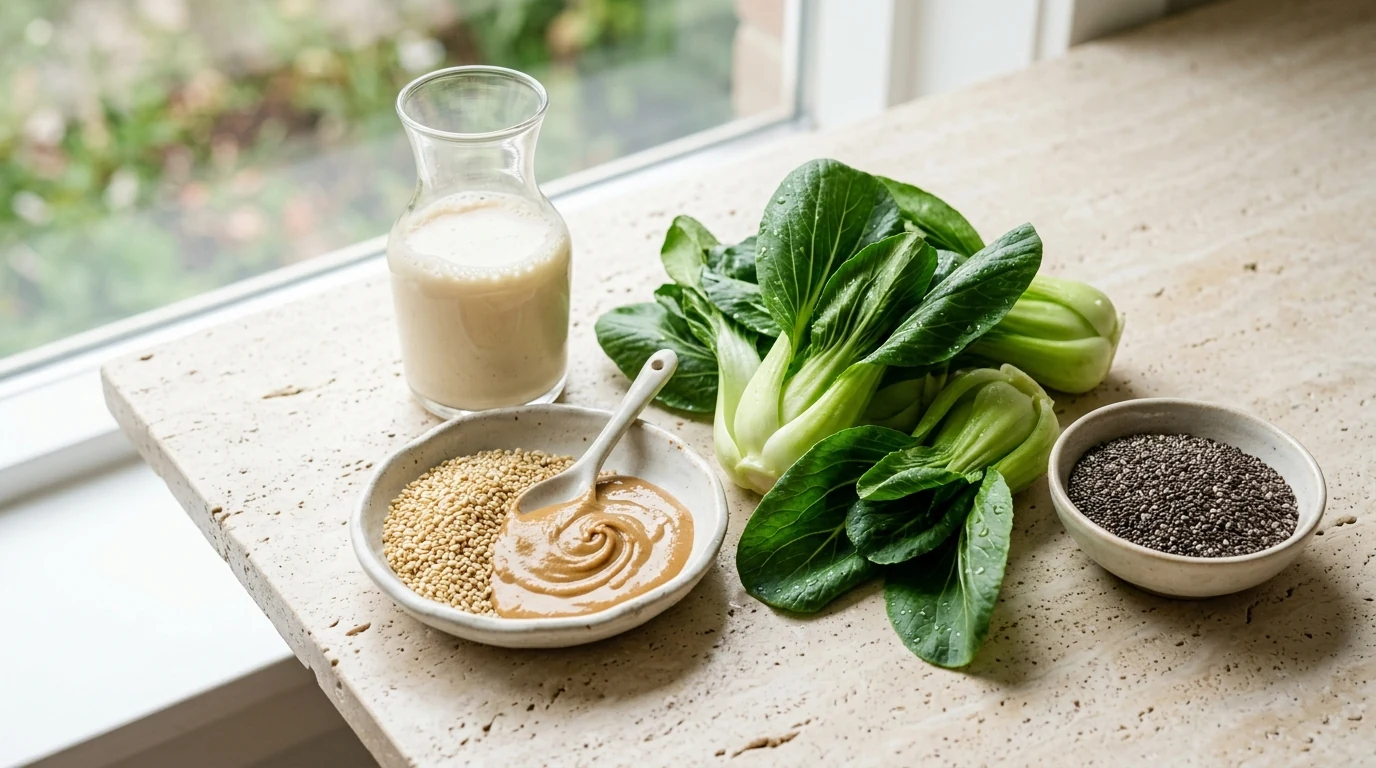
Intestinal calcium absorption occurs via active transcellular transport mediated by TRPV6 channels and Calbindin-D9k (regulated by active Vitamin D 1,25(OH)2D3) as well as passive paracellular diffusion. Low-oxalate plant foods like kale, collards, tofu, and chia seeds deliver high bioavailable calcium without animal saturated fat.
Pairing calcium-rich plant foods with Vitamin D (UV mushrooms/sunlight) and Vitamin K2 (fermented tempeh/natto) directs calcium directly into skeletal bone hydroxyapatite while preventing arterial calcification.
6-Stage Biological Journey: Calcium
Interactive pathway mapping Calcium ingestion, digestive release, membrane transport, and cellular bio-utilization.
Plant Calcium Ions
Calcium bound to citrate, malate, or phytate matrices in cruciferous greens & fortified foods.
Oral Mastication & Salivary Solubilization
High Whole Food Retention
Gastric Pass-Through
Best 100% Whole Food Plant-Based Sources of Calcium
Top nutrient-dense plant foods ranked by % Daily Value per standard serving.
Fortified Soy Milk
Organic Firm Tofu
Chia Seeds →
Cooked Collard Greens →
White Beans
Sesame Tahini →
Recommended Daily Allowance (RDA) & DRI Standards: Calcium
Dietary Reference Intakes (DRI) across human life stages established by the National Academies of Sciences.
| Life Stage Bracket | Requirement Target | Type | Upper Limit (UL) | Visual Scale |
|---|---|---|---|---|
| Infants (0–12 months) | 200 – 260 mg / day | AI | 1,000 – 1,500 mg | |
| Children (1–8 years) | 700 – 1,000 mg / day | RDA | 2,500 mg / day | |
| Adolescents (9–18 years) | 1,300 mg / day | RDA | 3,000 mg / day | |
| Adult Male (19–70 years) | 1,000 mg / day | RDA | 2,500 mg / day | |
| Adult Female (19–50 years) | 1,000 mg / day | RDA | 2,500 mg / day | |
| Pregnancy (19+ years) | 1,000 mg / day | RDA | 2,500 mg / day | |
| Lactation (19+ years) | 1,000 mg / day | RDA | 2,500 mg / day | |
| Post-Menopause / Senior | 1,200 mg / day | RDA | 2,000 mg / day |
100% Daily Value Achievement Combinations: Calcium
Practical whole-food meal pairings to hit 100% of your daily Calcium requirement effortlessly.
1 Serving Fortified Soy Milk
Prepared Chilled / Warm for maximum retention.
1 Serving Organic Firm Tofu + Chia Seeds
Combined meal pairing for optimal Calcium density.
Chia Seeds + Cooked Collard Greens
Diverse whole-food combination across two meal windows.
5-Stage Deficiency Progression Timeline: Calcium
Clinical timeline tracing tissue depletion from early asymptomatic bio-depletion to overt pathology for Calcium. Educational deficiency progression model
Biochemical Biomarkers
- Bone Mineral Density (BMD) T-score declines between -1.0 and -2.5.
Clinical Symptoms
- Mild muscle cramping, joint stiffness, and dental enamel weakness.
100% WFPB Therapeutic Protocol
Optimize daily calcium to 1,000 mg + Vitamin D3 + Vitamin K2.
Interactive Toxicity & Tolerable Upper Intake Level (UL): Calcium
Drag the slider to evaluate biological safety margins, upper intake ceilings, and toxicity thresholds for Calcium.
1,000 – 1,200 mg / day
1,200 – 1,800 mg / day
2,500 mg / day
> 2,500 mg / day
✅ Optimal Bio-Physiological Baseline (100% RDA)
Consuming calcium through whole plant foods (greens, beans, seeds, tofu) carries NO risk of hypercalcemia or vascular arterial calcification, unlike high-dose synthetic calcium carbonate pills.
Calcium Reference Calculator
Estimate your daily Calcium reference target using established Dietary Reference Intakes and relevant life-stage factors.
7-Day WFPB Meal Planner & Macro Balancer: Calcium
Scientifically calculated 100% plant-based meal plan optimized for Calcium density and bio-absorption.
Fortified Soy Milk & Chia Seed Oatmeal
Tofu Veggie Stir-Fry with Steamed Collard Greens
White Bean & Kale Soup with Tahini Drizzle
Handful of Roasted Almonds & Sesame Seed Bar
Categorized 100% WFPB Shopping List: Calcium
Interactive grocery checklist organized by plant food category to hit your weekly Calcium targets.
🛒 Fresh Produce
🛒 Legumes & Plant Proteins
🛒 Nuts, Seeds & Condiments
🛒 Fortified Plant Staples
Research & Evidence Intelligence Dashboard: Calcium
Human clinical trial meta-analyses, publication trends, and consensus confidence grades for Calcium.
10-Year Publication Trend: Calcium (2015 – 2024)
Official Scientific Research Authorities: Calcium
Verified data sources establishing international dietary standards and clinical recommendations for Calcium.
USDA FoodData Central
VerifiedStandard Reference analytical database for 100% whole plant food micronutrient density.
NIH Office of Supplements
VerifiedNational Institutes of Health official DRI intake tables and deficiency research.
World Health Organization
VerifiedWHO/FAO expert consultation on human vitamin and mineral requirements.
NASEM Food & Nutrition
VerifiedNational Academies of Sciences evaluation of tolerable upper intake levels (UL).
Calcium Knowledge Graph Explorer
Explore multi-dimensional entity connections linking Calcium to plant food matrices, physiological functions, and health outcomes.
Frequently Asked Questions: Calcium
Peer-reviewed answers to common questions regarding Calcium bioavailability, absorption, and safety.
Is plant-based calcium from greens as absorbable as dairy calcium?
Yes. Low-oxalate greens like kale, collard greens, and turnip greens have a calcium absorption rate of 40%–60%, which is higher than cow's milk (32%).
How do oxalates affect calcium absorption in spinach?
Spinach contains high oxalic acid, which binds calcium into insoluble calcium oxalate, reducing absorption to ~5%. Choose low-oxalate greens like kale, bok choy, and collards instead.
What role does Vitamin D play in plant calcium utilization?
Active Vitamin D stimulates intestinal production of TRPV6 channels and Calbindin-D9k proteins, increasing transcellular calcium absorption by up to 300%.
Why is calcium-set tofu an exceptional WFPB source?
Tofu prepared with calcium sulfate provides ~430 mg of highly bioavailable calcium per half-cup serving alongside 20g of clean plant protein.
Peer-Reviewed Scientific References: Calcium
Official clinical guidelines, NIH Dietary Reference Intakes, and peer-reviewed journal articles for Calcium.