Anthocyanins Evidence Guide
Water-soluble flavonoid pigments responsible for purple, blue, and ruby red plant colors that cross the blood-brain barrier, enhance endothelial nitric oxide, and protect the vascular glycocalyx.
Quick Scientific Facts: Anthocyanins
Key physiological targets, upper safety bounds, and bioavailability metrics.
Why Anthocyanins Matters
Glycosylated Flavonoid Polyphenols • Cyanidin, Delphinidin, Malvidin, Peonidin
Anthocyanins are water-soluble flavonoid pigments responsible for the deep purple, blue, and ruby red colors of berries and dark vegetables. Upon absorption, anthocyanin metabolites cross the blood-brain barrier and localize in hippocampal learning centers. They stimulate endothelial nitric oxide (NO) release, maintain microvascular glycocalyx thickness, improve insulin sensitivity, and enhance cerebrovascular blood flow.
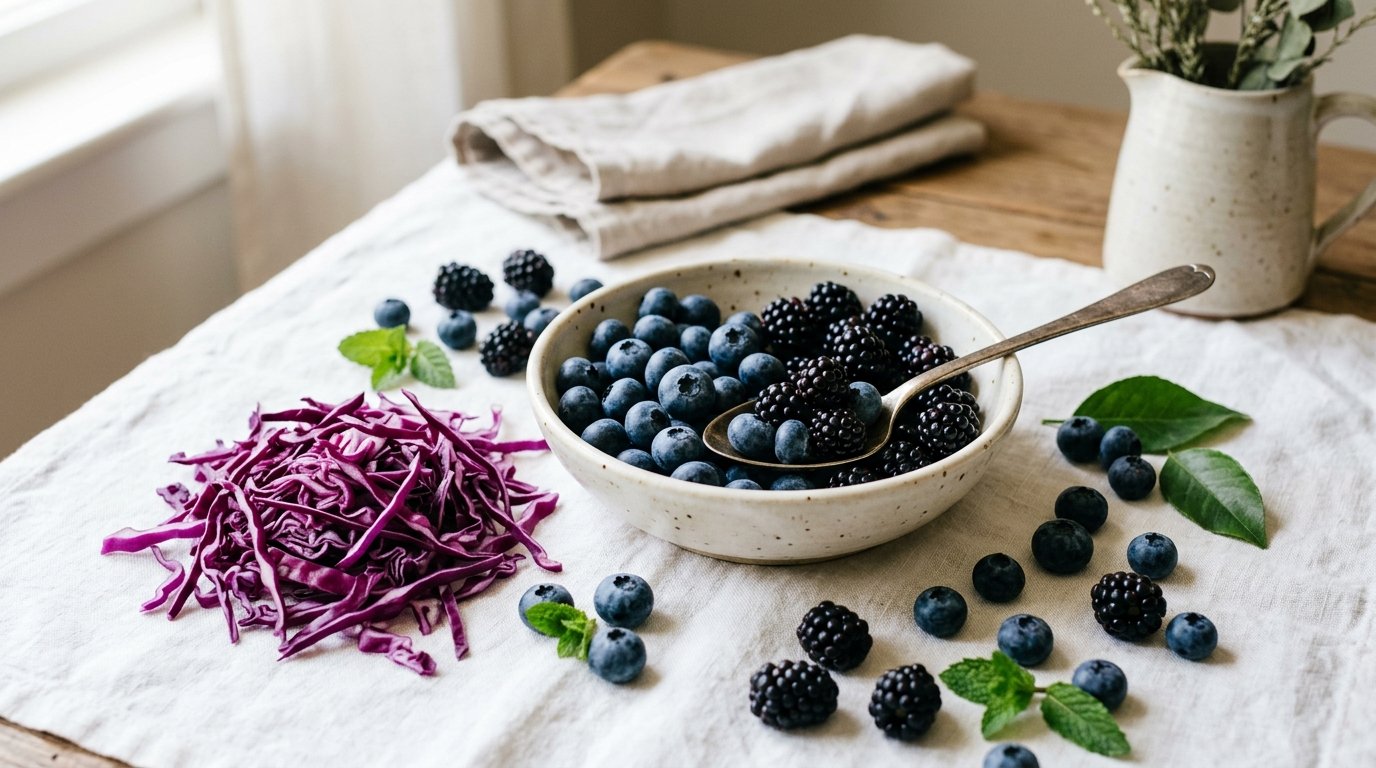
Consuming a colorful mix of berries (blueberries, blackberries, raspberries) provides diverse anthocyanin aglycones (cyanidin, delphinidin, malvidin) with superior antioxidant synergy compared to isolated extracts.
6-Stage Biological Journey: Anthocyanins
Interactive pathway mapping Anthocyanins ingestion, digestive release, membrane transport, and cellular bio-utilization.
Anthocyanin Glycosides
Released from deep purple and blue plant vacuoles during mastication.
Oral Mastication & Salivary Solubilization
High Whole Food Retention
Gastric Pass-Through
Best 100% Whole Food Plant-Based Sources of Anthocyanins
Top nutrient-dense plant foods ranked by % Daily Value per standard serving.
Wild Blueberries →
Fresh Blackberries
Purple Sweet Potato →
Raw Red Cabbage →
Tart Cherries
Black Currants
Recommended Daily Allowance (RDA) & DRI Standards: Anthocyanins
Dietary Reference Intakes (DRI) across human life stages established by the National Academies of Sciences.
| Life Stage Bracket | Requirement Target | Type | Upper Limit (UL) | Visual Scale |
|---|---|---|---|---|
| Pediatric / Children | Dietary Whole Foods | AI | Not Established (No adverse effects observed at dietary intakes >1,000 mg/day) | |
| Adolescents (14–18 years) | Age-Appropriate Intake | AI | Not Established (No adverse effects observed at dietary intakes >1,000 mg/day) | |
| Adult Male (19+ years) | 50 – 150 mg / day (Evidence-Based Cardiovascular & Cognitive Target) | AI | Not Established (No adverse effects observed at dietary intakes >1,000 mg/day) | |
| Adult Female (19+ years) | 50 – 150 mg / day (Evidence-Based Cardiovascular & Cognitive Target) | AI | Not Established (No adverse effects observed at dietary intakes >1,000 mg/day) | |
| Pregnancy (19+ years) | 50 – 150 mg / day (Evidence-Based Cardiovascular & Cognitive Target) | AI | Not Established (No adverse effects observed at dietary intakes >1,000 mg/day) | |
| Lactation (19+ years) | 50 – 150 mg / day (Evidence-Based Cardiovascular & Cognitive Target) | AI | Not Established (No adverse effects observed at dietary intakes >1,000 mg/day) | |
| Optimal Therapeutic Target | Enhanced Dietary Target | AI | Not Established (No adverse effects observed at dietary intakes >1,000 mg/day) |
100% Daily Value Achievement Combinations: Anthocyanins
Practical whole-food meal pairings to hit 100% of your daily Anthocyanins requirement effortlessly.
1 Serving Wild Blueberries
Prepared Raw Fresh / Frozen for maximum retention.
1 Serving Fresh Blackberries + Purple Sweet Potato
Combined meal pairing for optimal Anthocyanins density.
Purple Sweet Potato + Raw Red Cabbage
Diverse whole-food combination across two meal windows.
5-Stage Deficiency Progression Timeline: Anthocyanins
Clinical timeline tracing tissue depletion from early asymptomatic bio-depletion to overt pathology for Anthocyanins. Educational deficiency progression model
Biochemical Biomarkers
- Reduced endothelial nitric oxide bioavailability
- Subclinical thinning of the vascular glycocalyx
- Elevated oxidized LDL concentrations
Clinical Symptoms
- Reduced arterial elasticity and peripheral circulation
- Increased mental fatigue during prolonged cognitive work
- Mild elevation in inflammatory markers
100% WFPB Therapeutic Protocol
Target 100–200mg daily from wild blueberries and red cabbage.
Interactive Toxicity & Tolerable Upper Intake Level (UL): Anthocyanins
Drag the slider to evaluate biological safety margins, upper intake ceilings, and toxicity thresholds for Anthocyanins.
50 – 250 mg / day (From wild berries, purple sweet potatoes, and red cabbage)
250 – 500 mg / day (Cardiovascular, Endothelial & Cognitive Enhancement)
Not Established for Whole Foods
> 1,500 mg / day (Completely harmless; natural purple coloration in stool)
✅ Optimal Bio-Physiological Baseline (100% RDA)
Anthocyanins from whole food sources (berries, grapes, purple potatoes) are completely safe with zero toxicity.
Anthocyanins Reference Calculator
Estimate your daily Anthocyanins reference target using established Dietary Reference Intakes and relevant life-stage factors.
7-Day WFPB Meal Planner & Macro Balancer: Anthocyanins
Scientifically calculated 100% plant-based meal plan optimized for Anthocyanins density and bio-absorption.
Wild Blueberry & Blackberry Oatmeal with Ground Chia Seeds
Crunchy Red Cabbage, Apple & Walnut Slaw with Tahini Dressing
Fresh Tart Cherries or Frozen Black Currants
Baked Purple Sweet Potato with Black Beans & Steamed Greens
Categorized 100% WFPB Shopping List: Anthocyanins
Interactive grocery checklist organized by plant food category to hit your weekly Anthocyanins targets.
🛒 Dark Berries
🛒 Purple Vegetables
Research & Evidence Intelligence Dashboard: Anthocyanins
Human clinical trial meta-analyses, publication trends, and consensus confidence grades for Anthocyanins.
No verified research data available
Clinical trials and meta-analyses for Anthocyanins are currently being indexed.
Official Scientific Research Authorities: Anthocyanins
Verified data sources establishing international dietary standards and clinical recommendations for Anthocyanins.
USDA FoodData Central
VerifiedStandard Reference analytical database for 100% whole plant food micronutrient density.
NIH Office of Supplements
VerifiedNational Institutes of Health official DRI intake tables and deficiency research.
World Health Organization
VerifiedWHO/FAO expert consultation on human vitamin and mineral requirements.
NASEM Food & Nutrition
VerifiedNational Academies of Sciences evaluation of tolerable upper intake levels (UL).
Anthocyanins Knowledge Graph Explorer
Explore multi-dimensional entity connections linking Anthocyanins to plant food matrices, physiological functions, and health outcomes.
Frequently Asked Questions: Anthocyanins
Peer-reviewed answers to common questions regarding Anthocyanins bioavailability, absorption, and safety.
Why are wild blueberries higher in anthocyanins than regular cultivated blueberries?
Wild blueberries are smaller in size, meaning they have a much higher skin-to-flesh ratio where anthocyanins are concentrated, delivering up to twice the antioxidant capacity.
Do anthocyanins survive freezing in commercial berry packs?
Yes. Flash-freezing preserves nearly 100% of anthocyanin pigments and antioxidant capacity, making frozen berries just as potent as fresh ones.
How do anthocyanins cross the blood-brain barrier?
Anthocyanins cross the blood-brain barrier via glucose transporter GLUT1 and localize in hippocampal learning and memory centers.
What is the vascular glycocalyx and how do berries protect it?
The glycocalyx is the microscopic gel lining inside blood vessels that prevents plaque adhesion. Anthocyanins inhibit the enzymes that degrade this delicate barrier.
Does cooking purple sweet potatoes destroy their anthocyanins?
No. Purple sweet potato anthocyanins are naturally acylated, which makes them remarkably heat-stable and resistant to cooking breakdown.
Peer-Reviewed Scientific References: Anthocyanins
Official clinical guidelines, NIH Dietary Reference Intakes, and peer-reviewed journal articles for Anthocyanins.